Tech News
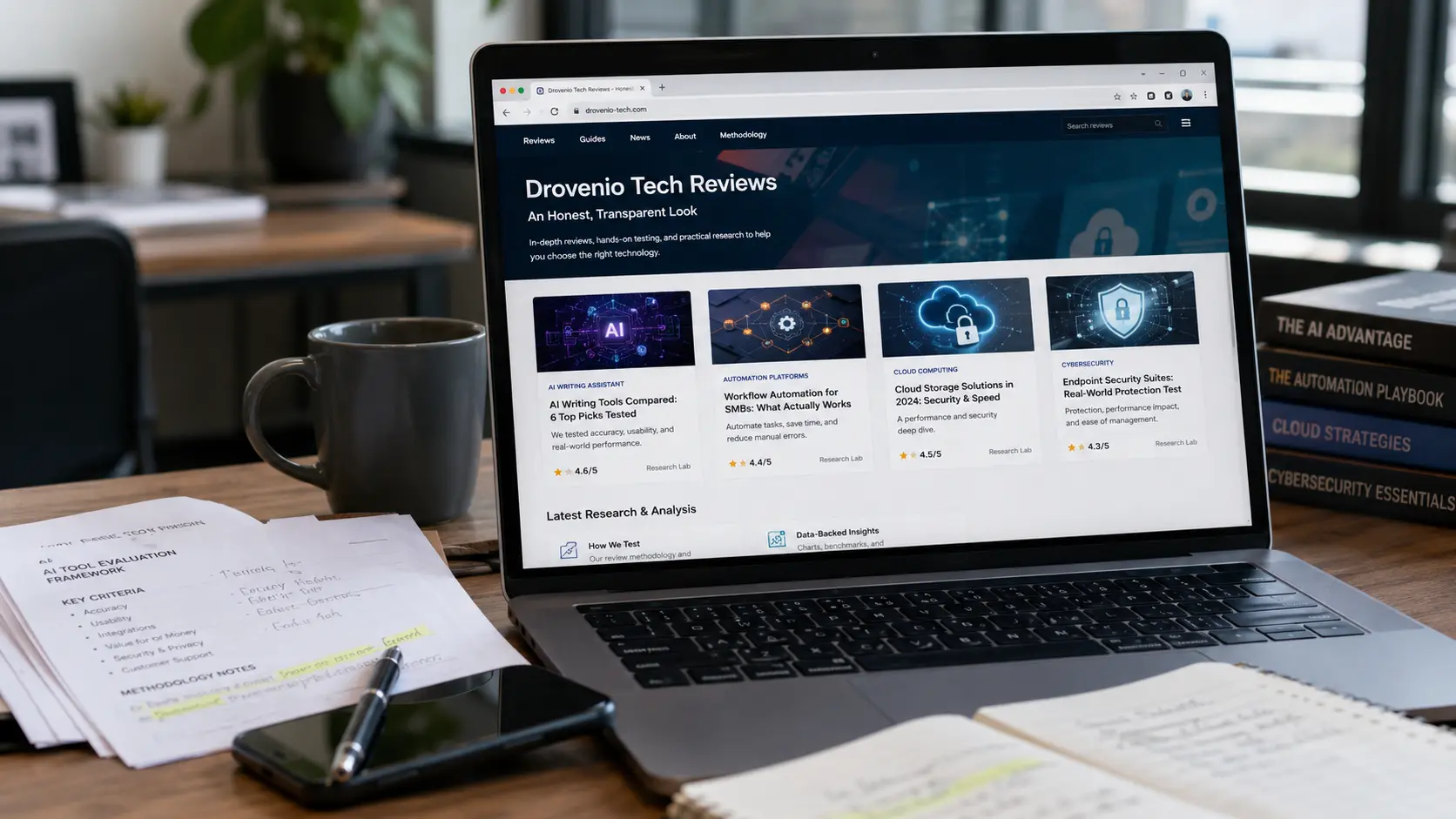
Drovenio Tech Reviews: An Honest, Transparent Look

Introduction
Search “Droven.io reviews,” and you’ll find dozens of articles answering the question. Read a handful of them back to back and something odd emerges: they say almost the same thing, in almost the same order, with almost none of them naming an actual author or showing evidence of anyone having actually used the site. Praise like “clear explanations” and “structured content” appears nearly verbatim across pages that have no visible connection to each other.
This same evaluation framework applies whether you’re reading about Drovenio, a competing tech blog, or the next AI tool comparison covered in our Drovenio AI News guide.
This page does two things most of that content doesn’t. First, it gives an honest, direct answer about what Drovenio’s tech review content actually is, including real limitations, not just praise. Second, and more usefully, it hands you a reusable framework for evaluating any tech review site’s credibility — authorship, methodology, evidence, disclosure — that applies whether you’re reading about Drovenio, a competing tech blog, or the next AI tool comparison you come across. For deeper coverage of the tools and platforms this framework applies to, see our companion Drovenio Latest Technology News pillar guide.
What Are Drovenio Tech Reviews?
Platform Overview: What This Content Actually Covers
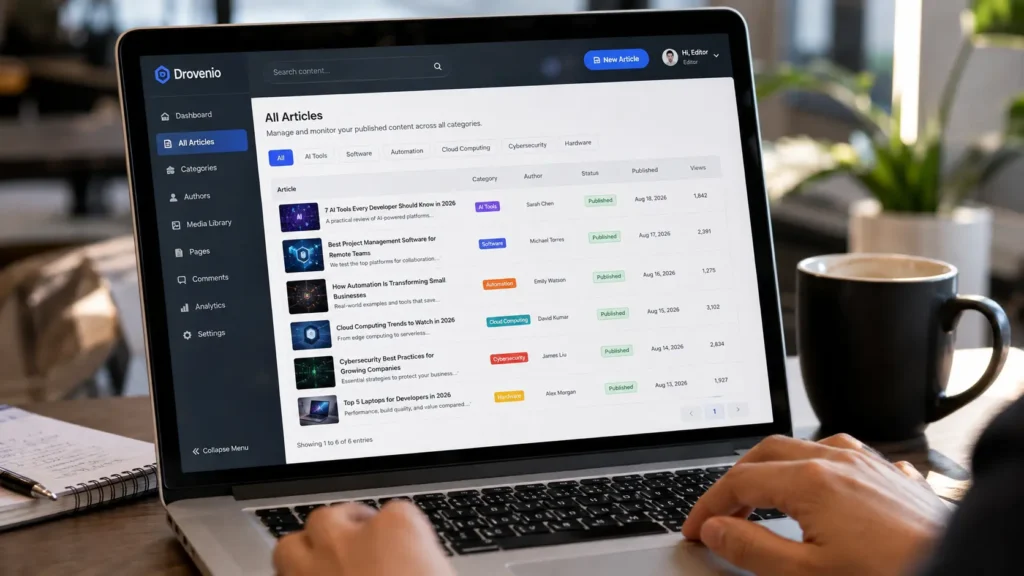
Drovenio’s tech review content sits within a broader technology content platform, alongside AI, automation, cloud, and cybersecurity coverage. Based on the site’s own stated positioning and the third-party coverage of it, the review content spans AI tools, software platforms, and to a lesser extent, hardware categories like edge-computing devices and enterprise gear — written, according to the platform’s own description, from an educational rather than commercial angle, without a stated affiliate relationship to the products discussed.
Is Droven.io Legit? An Honest, Direct Answer
Based on publicly available information, Drovenio appears to be a real, actively publishing content platform rather than a scam, a dead domain, or a placeholder site — several independent write-ups describe consistent publishing activity and a genuine topic structure spanning AI, automation, cloud, and related subjects. That’s a fair, positive answer to the core “is it legit” question. The more useful, less flattering answer sits alongside it: like most of the content about Drovenio circulating right now, the platform’s own review content is generally light on the specific trust signals covered in the next section — named authors, disclosed evaluation methodology, and visible original testing or evidence. “Real and active” and “fully meeting best-practice trust standards” are two different questions, and it’s worth answering both rather than only the first.
Who This Review Coverage Is Built For
This content is written for people trying to make an actual decision — whether to trust a specific AI tool review, whether a platform’s coverage is worth their time, or how to tell a credible source from a templated one — rather than people just curious about Drovenio as a brand name in isolation.
A Note on Adjacent Searches: IT Services and Remote Jobs
Some searches touching the Drovenio name are actually about something else entirely — “Drovenio IT services USA” or “Drovenio remote IT jobs” — which appear to stem from assumptions about the brand rather than confirmed offerings. Based on publicly available information, Drovenio functions as a content and editorial platform, not a staffing agency or IT services provider, and readers searching for either shouldn’t assume a connection exists without independently confirming it first.
How to Evaluate Any Tech Review Site’s Credibility
Authorship and Disclosed Methodology
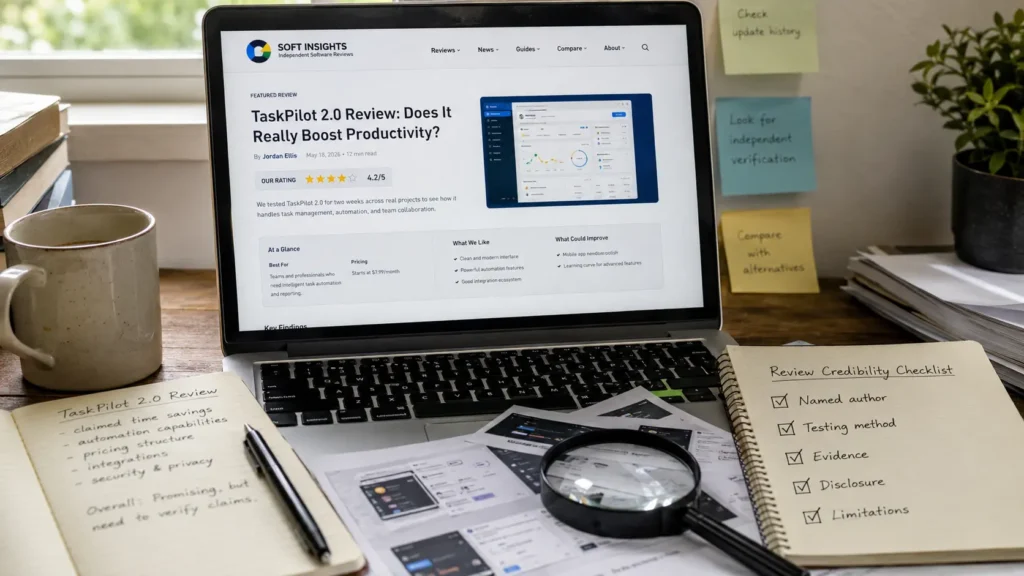
A credible review names who wrote it and, ideally, briefly explains how the evaluation was done — what was tested, over what time period, against what criteria. Its absence isn’t automatically disqualifying for every piece of content, but its consistent absence across an entire site’s review section is a meaningful signal, and it’s precisely what’s missing across most of the “Droven.io review” content currently online, including, by its own account, some of Drovenio’s own review pages.
Evidence of Actual Use vs. Marketing-Language Summaries
There’s a real difference between “this tool is powerful and easy to use” and a description of what specifically happened when someone used it — a task attempted, a result observed, a limitation hit. The first is marketing language dressed as a review; the second is evidence. Reading a handful of reviews side by side and asking whether any of them describe a concrete moment of use, rather than only adjectives, is a fast, practical filter.
Disclosure of Financial Relationships (FTC Guidelines, Affiliate Links)
In the US, FTC guidelines require clear disclosure when a review involves a financial relationship — an affiliate link, sponsored content, a free product provided by the company being reviewed. A review that recommends a paid tool without any visible disclosure statement isn’t necessarily biased, but the absence of a disclosure statement removes your ability to judge that for yourself, which is the actual point of the requirement.
Google’s E-E-A-T Framework, Explained Simply
Google evaluates content quality partly through what it calls E-E-A-T: Experience (has the author actually used the thing they’re writing about), Expertise (do they have relevant knowledge), Authoritativeness (is the source recognized as credible in its field), and Trustworthiness (is the content accurate, transparent, and honest about limitations). It’s originally a search-ranking framework, but it doubles as a genuinely useful personal checklist — the same four questions work whether you’re deciding how much to trust a search result or a review you found through one.
Expert Insight: “People assume expertise is the hard part to fake, and it’s actually the easiest,” a media literacy consultant told us. “Anyone can write confidently about a topic they’ve only skimmed. What’s much harder to fake convincingly is experience — a specific detail, a real limitation, a moment where the thing didn’t work as expected. If a review never stumbles into an imperfection, that’s usually the tell, not the polish.”
The “Reviewing the Reviewer” Pattern
Why So Many “Droven.io Review” Articles Read Nearly Identical
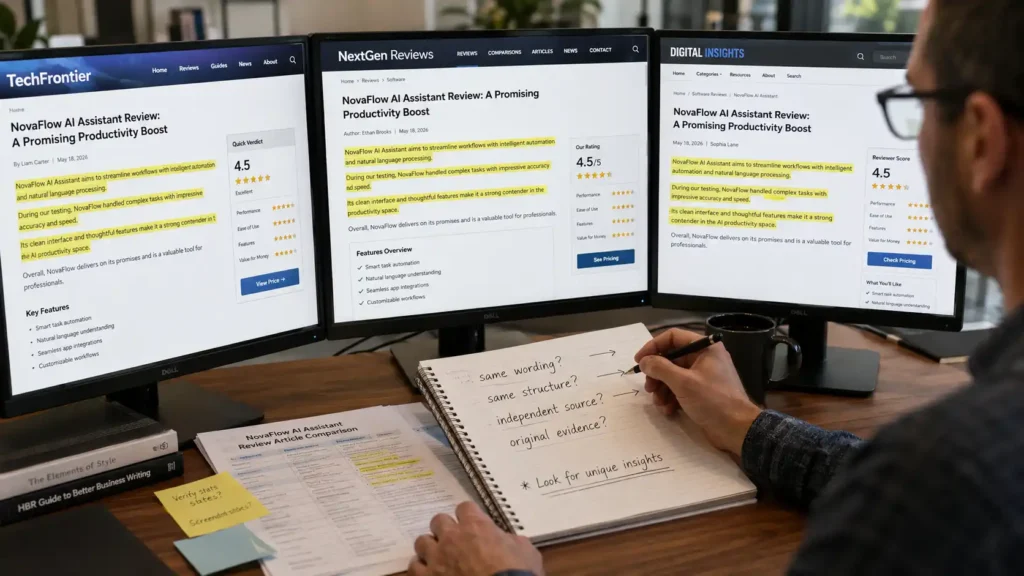
This is worth naming plainly rather than working around: a search for “Droven.io reviews” surfaces multiple articles from unrelated-looking domains using strikingly similar phrasing and structure — praising “clear explanations” and “structured content,” describing the same handful of topic categories, and consistently lacking a named author or any evidence of firsthand platform use.
As a concrete, checkable example: across a sample of results reviewed for this article, phrases functionally equivalent to “clear explanations, structured content, and practical insights” appeared across several separately branded sites covering the same topic, each without a byline and without describing a specific article, feature, or moment of actually using the platform.
This is a recognizable content pattern, not a coincidence: it’s consistent with SEO-driven content produced to rank for a trending keyword phrase rather than written by someone who actually explored the site being described. That doesn’t necessarily mean the underlying claims are false — but it does mean none of them should be taken as independent confirmation of each other, since they may share a common origin (a content brief, a shared writing tool, or simply one article being paraphrased into several) rather than representing several independent evaluations.
How to Spot AI-Generated or Templated Review Content

A few practical tells: near-identical phrasing appearing across supposedly unrelated sites, a review that lists features without ever describing a specific moment of use, a conclusion that reads as generically positive regardless of the specific product, and an absence of any detail that would only be known by someone who’d actually spent time with the product. None of these individually proves AI generation or templating, but several appearing together is a reasonable basis for skepticism.
What This Means for Trusting Any Single Review
The practical takeaway isn’t “don’t trust reviews” — it’s “don’t treat multiple similar-sounding reviews as multiple independent data points” if they share the hallmarks above. One well-evidenced review with a named author and visible methodology is worth more than ten templated ones repeating the same three adjectives.
AI and Software Tool Reviews
How AI Writing Tools Get Compared: ChatGPT vs. Copilot vs. Claude
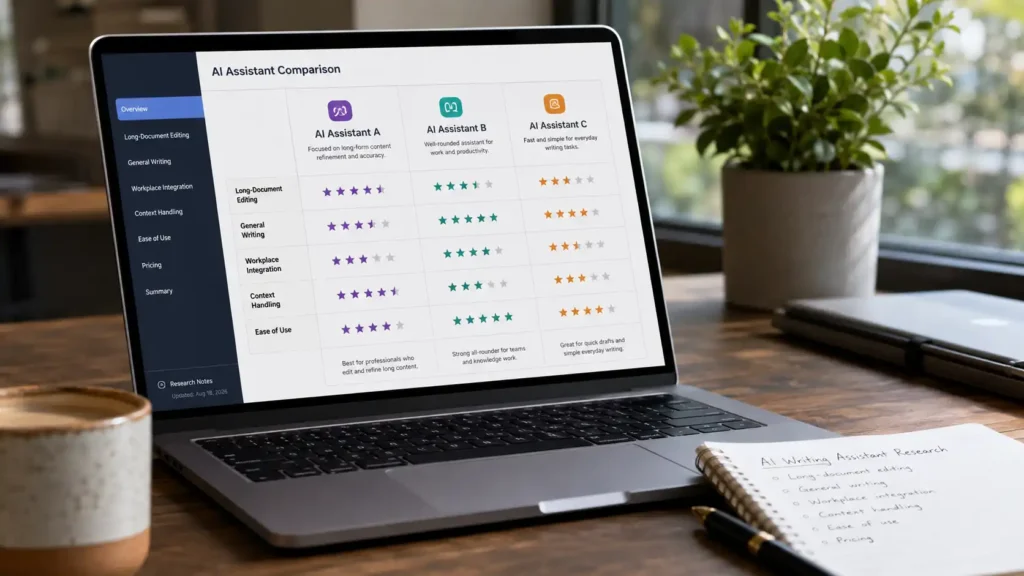
A genuinely useful AI tool comparison names the actual products and the actual differences that matter for a specific task, rather than describing “AI writing tools” abstractly. ChatGPT is widely used as a general-purpose assistant with broad plugin and integration support; Microsoft Copilot’s advantage is deep integration into Microsoft 365 documents and email, useful specifically if that’s where your work already lives; Claude is frequently noted for longer-context handling and careful, detailed writing on complex documents; Notion AI sits closer to a workspace-embedded assistant, useful specifically for teams already organizing work inside Notion rather than as a standalone destination.
None of these is universally “best” — the right comparison criteria depend on the specific task (drafting quick copy vs. editing a long technical document vs. working inside an existing Microsoft or Notion workflow), which is exactly the kind of specific, task-based criteria missing from the generic “AI tools” language across most competing review content.
How Automation Tools Get Compared: Zapier vs. Make
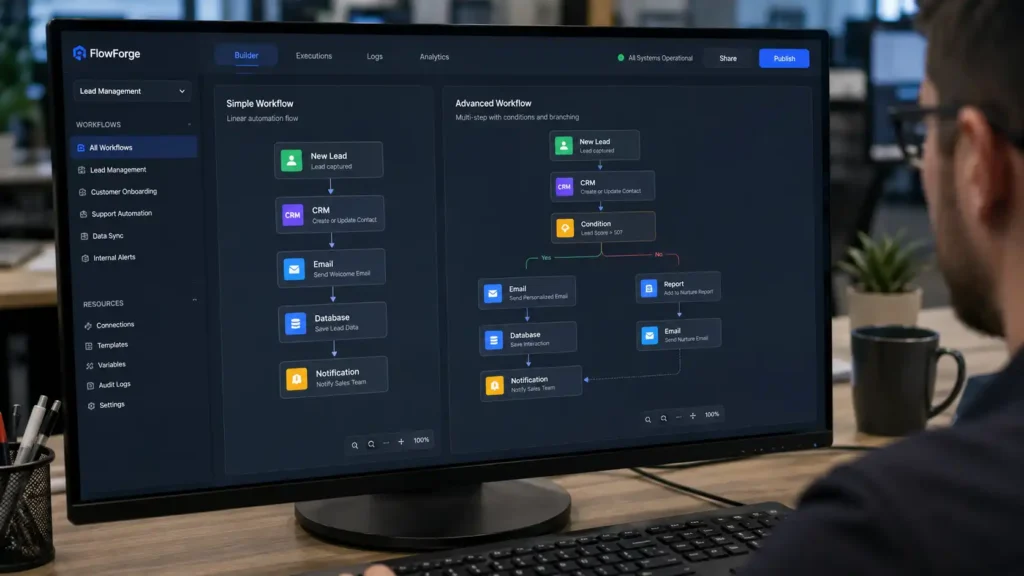
As covered in more depth on our automation news page, Zapier and Make serve a similar core purpose — connecting apps without code — but differ in interface philosophy: Zapier favors a simpler, more linear setup that’s faster to learn, while Make’s visual, flowchart-style builder offers more control for complex, branching workflows at the cost of a steeper learning curve. A real review names this specific tradeoff rather than describing both as generically “powerful automation tools” — as covered in more depth in our Drovenio Automation News guide.
What Criteria Actually Matter for a Software Review
Regardless of category, the criteria that actually predict whether a tool will work for you are consistent: how steep the learning curve is for someone at your skill level, what it costs at your actual expected usage (not the advertised starting price), what happens when something goes wrong (support quality, documentation), and what you’d lose if you switched away later. A review that addresses these specifically is doing something structurally different from one that lists features and calls the tool “powerful” and “intuitive.”
Hardware and Gadget Reviews
Edge Computing Devices: What Gets Evaluated

A useful edge-computing device review focuses on latency in the specific task it’s built for (how fast it processes data locally versus round-tripping to the cloud), power consumption if it’s running continuously, and how well it integrates with whatever cloud or automation platform it. This connection point is covered from the infrastructure side in our Drovenio Cloud Computing News guide, which explains why latency and integration matter so much for edge-computing hardware reviews.
AR Wearables and Enterprise Hardware Coverage
AR (augmented reality) wearables reviewed for business use are typically judged on different criteria than consumer AR headsets — battery life across a full shift, durability in an industrial or warehouse setting, and how well the device integrates with existing enterprise software matter more than display resolution or gaming performance. Enterprise hardware reviews generally, whether AR devices or other business equipment, should specify the use case they’re evaluating for rather than offering a single verdict that’s supposed to apply to every buyer.
Why Hardware Reviews Need Different Criteria Than Software
Software can be updated after a review is published; hardware generally can’t be meaningfully changed once purchased, which raises the stakes on getting the evaluation right the first time. A hardware review missing physical testing details — how it performed over real use, not just a spec sheet comparison — is a weaker review than one for software, where a spec comparison alone at least tells you something concrete and verifiable.
Review Site Monetization Models Explained
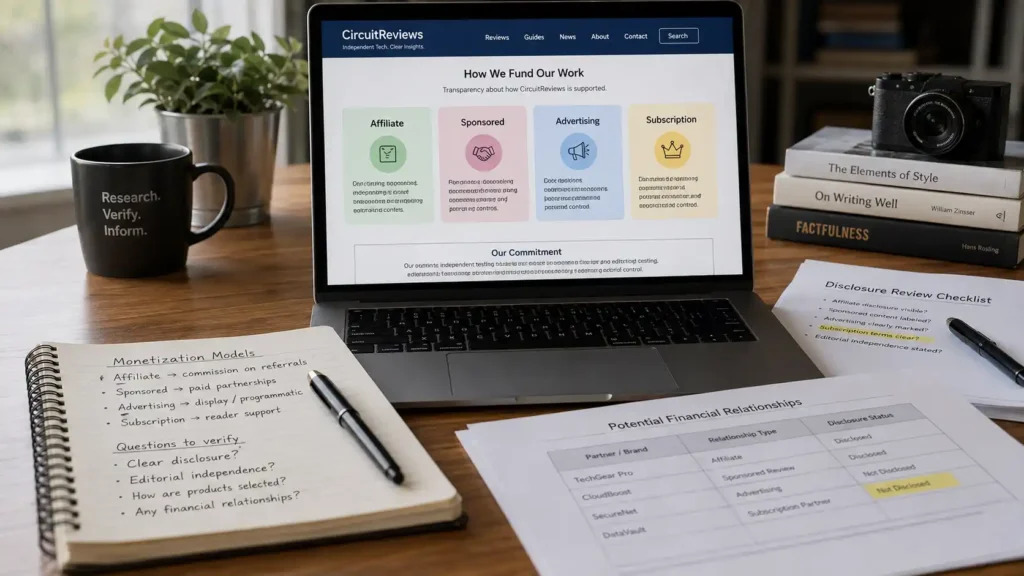
Affiliate-Driven Reviews
Affiliate reviews earn a commission when a reader clicks through and buys the reviewed product. This doesn’t automatically make a review dishonest, but it does create a structural incentive to lean positive, particularly toward products offering the highest commission rather than the best fit for the reader. The presence of affiliate links, disclosed or not, is worth noticing specifically when a review recommends a more expensive option without clearly explaining why it’s worth the difference.
Sponsored and Paid Placement Content
Sponsored content is paid for directly by the company being featured, and under FTC guidelines should be clearly labeled as such — “sponsored,” “paid partnership,” or similar. The core difference from an affiliate review is that payment happens regardless of whether a reader ultimately buys anything, which removes even the (limited) alignment an affiliate model has with actually helping the reader make a good choice.
Ad-Supported and Subscription Models
Ad-supported sites earn revenue from general advertising rather than the specific products reviewed, which structurally reduces (though doesn’t eliminate) the incentive to favor any one product. Subscription-funded review sites, where readers pay directly for access, have arguably the cleanest incentive alignment, since revenue depends on reader trust and satisfaction rather than any single vendor relationship — though subscription models are still relatively rare in general tech review content compared to advertising and affiliate approaches.
Why the Model Behind a Review Changes What You Should Trust
None of these models make a review automatically untrustworthy — plenty of affiliate-funded content is genuinely careful and well-evidenced, and plenty of “independent” content is low-effort and vague. What the monetization model tells you is where to apply extra scrutiny: check whether an affiliate review’s top pick happens to be the highest-commission option, whether sponsored content is labeled at all, and whether an “unbiased” claim is backed by visible evidence or just asserted.
| Model | Who Pays | Incentive Risk | What to Check |
| Affiliate | Commission on purchase | Leans toward highest-commission product | Does the top pick match the highest payout? |
| Sponsored | Featured company, flat fee | Payment regardless of reader outcome | Is “sponsored” or “paid partnership” clearly labeled? |
| Ad-supported | General advertisers | Lower, indirect product bias | Is content still specific, or generically positive? |
| Subscription | The reader directly | Lowest — aligned with reader trust | Rare model; verify it’s genuinely reader-funded |
Case Study Section — Evaluating a Review in Practice
Case Study 1: Cross-Referencing Three Reviews Before an AI Tool Purchase
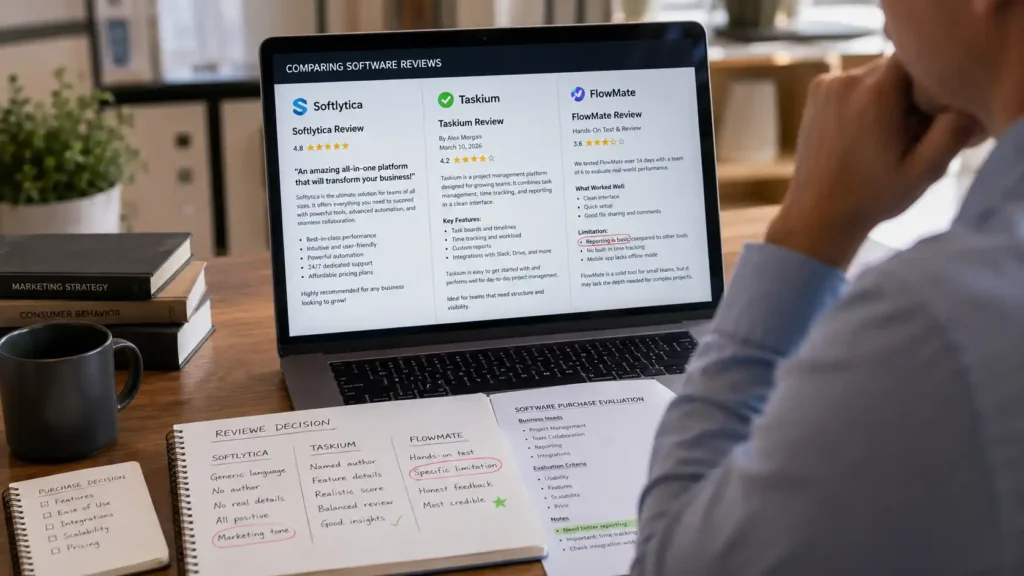
A marketing manager evaluating an AI writing tool for her team found three reviews recommending it, all describing it as “powerful” and “easy to use.” Rather than deciding based on that, she checked each review for a named author and specific evidence of use — one had neither, one had a named author but described only features without a usage example, and one included a specific walkthrough of a real drafting task with a described limitation the tool hit partway through.
She weighted the third review far more heavily, reached out to a colleague at another company who’d used the tool for a second opinion, and ultimately made her decision based on a live trial rather than any of the reviews alone. The reviews served as a starting point for questions to test, not a substitute for testing them herself — which is a reasonable, generalizable way to use any single review regardless of topic.
Case Study 2: Spotting a Templated Review Pattern Across Multiple Sites
A small business owner researching a cloud automation platform noticed, after reading several “reviews,” that three of them used the identical phrase “streamlines your workflow with powerful AI-driven automation” almost word for word. Recognizing the pattern described earlier in this guide, he treated those three as effectively one data point rather than three independent confirmations, and specifically sought out a fourth source — a discussion thread where actual users described real experiences, including complaints the templated reviews hadn’t mentioned at all. The templated content wasn’t necessarily false, but it also wasn’t the independent confirmation it appeared to be at first glance.
Case Study 3: A Business Decision Made on an Unverified Review — What Went Wrong
A small accounting firm selected a cybersecurity monitoring tool based primarily on a single highly positive review that turned out, on later inspection, to have no disclosed methodology and used marketing language nearly identical to the product’s own website copy. The tool underperformed relative to the firm’s actual compliance needs — details covered in our Drovenio Cybersecurity News guide — and the firm ended up switching providers within the year. Absorbing both the wasted subscription cost and the switching effort. The firm’s own retrospective was blunt: the review had read persuasively, but nobody had checked whether it was actually evidence-based before relying on it for a real purchase decision.
Expert Tips Section — Building Your Own Evaluation Habit
A Reusable Checklist for Evaluating Any Tech Review Site
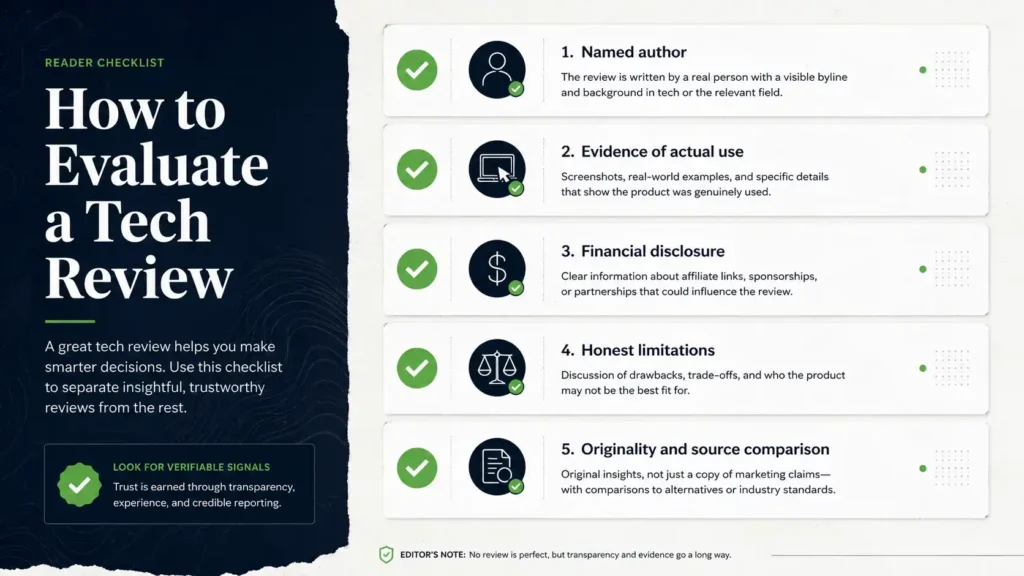
- Is there a named author, and does their background make sense for this topic?
- Does the review describe a specific instance of use, not just adjectives?
- Is any financial relationship (affiliate, sponsored) disclosed clearly?
- Does the review acknowledge any limitation or downside, or is it uniformly positive?
- Does similar phrasing appear verbatim on other, supposedly unrelated sites?
Questions to Ask Before Trusting a Single Review
Would this review’s conclusion change if the product were free versus if the reviewer earned a commission on it? Does the review compare the product against named alternatives, or does it exist in isolation with nothing to weigh it against? Is the “unbiased” or “honest” claim actually demonstrated by the content, or just stated as a label?
Expert Insight: “The biggest tell I look for isn’t bias — everyone has some,” a media literacy consultant told us. “It’s specificity. A reviewer who actually used something can tell you the moment it frustrated them. A reviewer who didn’t can only tell you it’s ‘intuitive.’ That one distinction catches most low-effort content before you even get to checking who wrote it.”
How to Cross-Reference Reviews Efficiently
Read two or three sources with a specific eye for disagreement, not just confirmation — genuine independent reviews rarely agree on every point, and near-total agreement across multiple “independent” sources is itself worth treating as a mild red flag rather than reassurance, consistent with the templated-content pattern covered earlier. When possible, seek out a discussion forum or community thread alongside formal reviews; unpolished, specific complaints from actual users often surface details a published review smooths over.
Applying This Same Framework Across the Rest of This Cluster
The checklist above isn’t specific to Drovenio — it applies directly to evaluating any claim across the AI tools, automation platforms, cloud providers, and security vendors covered throughout this series. Our AI news page covers how to vet an AI vendor’s real capabilities, our automation news page covers vetting automation tool claims, and our cloud computing news page covers evaluating a cloud provider — all of it rests on the same underlying habit: check for evidence before trusting a claim, regardless of how confidently it’s stated.
FAQ
It’s an editorial content section discussing AI tools, software, and some hardware categories — not a retailer, and not a paid product-ranking service.
No confirmed affiliate or financial relationship is publicly documented for Drovenio’s own content. Readers should still independently verify any specific claim, and apply the same disclosure check covered in this guide to any review, on any site, before relying on it.
Look for a named author, evidence of specific, actual use rather than only adjectives, clear disclosure of any financial relationship, and honest acknowledgment of limitations rather than uniform praise.
Coverage spans AI tools and software more heavily, with some coverage of hardware categories like edge-computing devices and enterprise or wearable technology.
It can’t be confirmed definitively without direct access to each site’s production process, but multiple articles across supposedly unrelated domains use strikingly similar phrasing, structure, and generic praise with no named authors — a pattern consistent with templated or AI-assisted content produced to rank for a trending keyword, discussed in more detail earlier in this guide.
Those pages explain trends, tools, and concepts broadly. This page focuses specifically on how to evaluate reviews and claims about those tools — a skill that applies across the entire cluster, not just to Drovenio itself.
Conclusion
The honest answer to “is Droven.io legit” is more useful than a simple yes or no: it appears to be a real, active platform, and at the same time, most of the content circulating about it — including some of its own review coverage — falls short of the trust signals that actually matter: named authorship, disclosed methodology, visible evidence, and honest acknowledgment of limitations. That gap is worth understanding not because Drovenio is uniquely flawed, but because the same gap shows up across a huge share of tech review content generally — editorial reviews, aggregators like G2 and Capterra, launch platforms like Product Hunt, buyer’s guides, and best-of lists alike — and the “reviewing the reviewer” pattern described in this guide is a genuine, checkable example of it happening in real time.


Introduction
Most drovenio cybersecurity news says the same three things: threats are rising, AI is changing the game, and businesses need to take security seriously. All true, and none of it tells you anything you can actually act on. What’s missing almost everywhere is the specific part — what a breach actually costs, which defenses genuinely matter versus which are security theater, and what to do in the first hour after something goes wrong.
This page fills that gap, and it starts with something most cybersecurity content covering this exact topic oddly avoids: if you’ve come across a “Droven io Cybersecurity Updates” app or APK file claiming to deliver this content, that’s worth pausing on before you install anything — more on exactly why in the section below. Beyond that immediate question, this guide covers the real 2026 threat landscape, sourced breach-cost data, the specific defenses worth prioritizing on a limited budget, and a practical incident response checklist. For how these threats intersect with AI tools and cloud infrastructure specifically, see our companion Drovenio Latest Technology News and Drovenio Cloud Computing News pages — this page focuses on security itself.
What Is Drovenio Cybersecurity News?
Platform Overview: Editorial Content, No Security Product Affiliation
Drovenio cybersecurity news is editorial content — explanatory articles about threats and defenses — not a security product, monitoring service, or app. This page has no financial relationship with any security vendor mentioned below, and it isn’t distributed as a download of any kind. That distinction matters more here than on any other page in this cluster, for a reason worth addressing directly.
Is the “Droven io Cybersecurity Updates” APK Safe to Download?
Searches for this topic sometimes surface a “Droven IO Cybersecurity Updates” app offered as an APK file outside the official Google Play Store. This is worth real caution, not because Drovenio-branded content is inherently suspicious, but because of a basic security principle this page is otherwise trying to teach: legitimate editorial content doesn’t need an installable app, let alone one distributed as a sideloaded APK rather than through an official app store. APK files from outside official stores bypass the security review those stores perform, and installing one grants it whatever permissions it requests — a real risk regardless of what the app claims to contain. The straightforward, safer approach: read cybersecurity content in a browser, and treat any “security update app” you’re asked to sideload with the same skepticism you’d apply to an unsolicited attachment — which, notably, is exactly the kind of judgment call the phishing section below covers.
Who This Cybersecurity Coverage Is Built For
This content is written for people making real security decisions without a dedicated security team — small business owners deciding where limited budget should go first, remote workers securing their own setup, and anyone trying to separate genuine risk from headline-driven anxiety.
The 2026 Cyber Threat Landscape
Ransomware: From Encryption to Double Extortion

Ransomware has evolved past simply locking a victim’s files. Modern ransomware groups increasingly use “double extortion”: stealing sensitive data before encrypting it, then threatening to publish that data publicly if the ransom isn’t paid — a tactic that defeats the old defense of “we have backups, we don’t need to pay,” since backups restore access but don’t prevent a leak. This shift is a major reason ransomware remains one of the most damaging attack categories, even as backup practices have generally improved industry-wide.
Phishing and Business Email Compromise (BEC)

Phishing remains the most common entry point for a breach, and business email compromise — where an attacker impersonates an executive or vendor to trick an employee into a wire transfer or sensitive data request — has grown into one of the costliest specific phishing variants, precisely because it targets a routine business process (paying an invoice, approving a request) rather than trying to install malware directly.
Supply Chain and Third-Party Risk
A supply chain attack compromises a trusted vendor or software provider to reach many downstream targets at once, rather than attacking each target directly. It’s grown into a serious concern because it exploits a genuine blind spot: a business can have excellent internal security and still be exposed through a vendor’s weaker practices, since that vendor typically has some level of trusted access to internal systems or data.
The 2020 SolarWinds breach remains the reference case for why this category of attack matters: attackers compromised a widely used IT management tool’s software update, which then quietly distributed malicious code to thousands of the vendor’s customers — including multiple US federal agencies — through what looked like a routine, trusted update.
A more recent, smaller-scale but common pattern: a business’s customer support platform or payment processor gets breached, and every business using that platform has to assess its own exposure, even though the breach never touched their own systems directly.
Credential Theft and Credential Stuffing
Credential theft — stealing usernames and passwords, often through phishing or a breach of an unrelated service — feeds a related technique called credential stuffing, where attackers use large sets of stolen login credentials, frequently traded or sold on the dark web, to automatically try logging into other accounts, betting that people reuse passwords across services. It’s a high-volume, low-effort attack precisely because password reuse remains common, which is part of why multi-factor authentication, covered later in this guide, matters as much as it does. A related but distinct threat worth knowing: DDoS (Distributed Denial-of-Service) attacks, which don’t steal data at all but instead flood a system with traffic to knock it offline — a different goal (disruption rather than theft) that calls for different defenses, typically handled at the network or hosting level rather than through the access controls that stop credential-based attacks.
AI’s Double Role in Cybersecurity

How Attackers Use AI: Smarter Phishing and Automated Attacks
AI has removed some of the traditional tells that used to make phishing easier to spot — poor grammar, awkward phrasing, generic greetings. AI-generated phishing can now be personalized, well-written, and tailored to a specific target’s role or recent activity, making it meaningfully harder to catch on instinct alone. AI also enables attackers to automate reconnaissance — scanning for vulnerable systems or gathering information about a target company at a scale that would have required significant manual effort before.
How to Recognize an AI-Generated Phishing Attempt
Since grammar and tone are no longer reliable indicators, the more useful checks have shifted toward context and urgency. Be more cautious of messages creating time pressure (“respond within the hour”), requests that bypass a normal process (a payment approved outside the usual channel), and any message asking you to act on a link or attachment you weren’t expecting — regardless of how polished the writing looks. Verifying a request through a separate channel (a phone call to a known number, not one provided in the message itself) remains one of the most reliable defenses precisely because it doesn’t depend on spotting a writing-quality tell that AI has largely eliminated.
How Defenders Use AI: Faster Threat Detection
On the defensive side, AI-powered tools can analyze network activity at a scale and speed no human security team could match, flagging unusual patterns — a login from an unexpected location, an unusual volume of data being accessed — that might indicate a compromise in progress. This is part of why detection times have generally improved industry-wide even as attack sophistication has also increased; it’s genuinely an arms race, not a one-sided story.
How This Connects to Drovenio’s AI News Coverage
Our AI news page covers “shadow AI” — employees using unapproved AI tools with company data — as a growing governance concern, and it’s directly relevant here: An employee pasting sensitive data into an unvetted AI tool is a security exposure regardless of intent — the AI governance conversation covered in our Drovenio AI News guide and the cybersecurity conversation here are, in practice, the same risk viewed from two departments.
What a Data Breach Actually Costs
Sourced Breach Cost Data: What Independent Research Shows
The financial stakes are well documented, not just theoretical. According to IBM’s 2025 Cost of a Data Breach Report, conducted with the Ponemon Institute, the global average cost of a breach fell to $4.44 million — the first year-over-year decline in five years, credited largely to faster detection through AI-powered security tools.
U.S. organizations didn’t see the same relief, with average breach costs climbing to roughly $10.22 million, driven by steeper regulatory fines and slower detection. Separately, Verizon’s annual Data Breach Investigations Report has consistently found that the large majority of breaches trace back to a human element — a phishing click, a stolen credential, a misconfiguration — rather than a sophisticated technical exploit, reinforcing why the training and access-control practices covered throughout this guide matter as much as any specific technology purchase. The IBM/Ponemon report also found that most breached organizations still lack a formal AI governance policy, and breaches involving unauthorized “shadow AI” carried a meaningfully higher price tag than breaches without that factor — directly echoing the connection to our AI news coverage above.
Expert Insight: “The number that surprises people isn’t the ransom demand,” a cybersecurity consultant who advises small and mid-market businesses told us. “It’s everything after — the downtime, the customer notification costs, the legal fees, the reputational hit. Businesses that only budget for ‘what if we get hit’ based on the ransom amount are budgeting for a fraction of the real cost.”
Why Small Businesses Are Common, Not Rare, Targets
A persistent misconception is that small businesses fly under attackers’ radar because they’re less valuable targets. The opposite is generally true: small businesses are frequent targets precisely because they often have weaker defenses than large enterprises while still holding valuable data — customer payment information, employee records — and attackers increasingly use automated tools that don’t discriminate by company size, scanning broadly for any exploitable weakness rather than hand-selecting large, high-profile targets.
Is Cyber Insurance Worth It?
Cyber insurance can help offset the costs covered above — breach response, legal fees, business interruption — but it’s not a substitute for basic defenses, and most policies now require a baseline level of security (MFA, for instance) as a condition of coverage, with claims sometimes denied if that baseline wasn’t actually in place at the time of the incident. For a small business, it’s generally worth evaluating once there’s meaningful sensitive data at stake, with the understanding that the policy is a financial backstop for when defenses fail, not a replacement for having them.
Core Defenses Every Business Needs
Multi-Factor Authentication: Authenticator App vs. SMS vs. Hardware Key

Multi-factor authentication (MFA) requires a second form of verification beyond a password, and it remains one of the single most effective defenses against credential theft — even if an attacker has a stolen password, MFA blocks most automated attempts to use it. Not all MFA is equally strong, though.
| Method | Security Level | Common Vulnerability | Best For |
| SMS code | Basic | SIM-swapping attacks | Better than no MFA; low-risk accounts |
| Authenticator app | Strong | Phishing if code is relayed in real time | Most business accounts, day-to-day use |
| Hardware security key | Strongest | Physical loss (requires backup key) | Admin access, financial systems, high-risk accounts |
Hardware security keys offer the strongest protection since they require physical possession of the device itself, but they’re typically reserved for higher-risk accounts given the added cost and setup friction.
Zero Trust Architecture in Plain Terms
Zero trust means no user or device is automatically trusted, even one already inside the company network — every access request gets verified based on identity, device health, and context, rather than assuming anyone past the “front door” is safe. In practice, for a small business, this looks less like a single product purchase and more like a set of habits: requiring MFA everywhere, limiting each employee’s access to only the systems their role actually requires, and not assuming that a device connected to the office Wi-Fi is automatically safe.
EDR and Endpoint Security Basics
Endpoint Detection and Response (EDR) tools monitor individual devices — laptops, servers, phones — for suspicious activity, going beyond traditional antivirus software by watching behavior patterns rather than just matching against a list of known malware or a static CVE (Common Vulnerabilities and Exposures) database. For a small business, EDR is generally a reasonable investment once the company has enough devices and enough sensitive data at stake that a compromised laptop could cause real damage; for a very small operation, a well-configured built-in security suite paired with the other defenses in this section may be a reasonable starting point instead.
Security Awareness Training That Actually Works
Training that consists of an annual slideshow nobody remembers isn’t training that changes behavior. What tends to actually work: short, frequent reminders rather than one long annual session, real simulated phishing tests that give people a low-stakes chance to practice catching a suspicious message, and a workplace culture where reporting a mistake (clicking a bad link) is treated as useful information rather than something to hide out of embarrassment — since the fastest containment happens when someone reports the click immediately rather than staying quiet.
Expert Insight: “The single biggest predictor of how bad an incident gets isn’t the sophistication of the attack,” a cybersecurity consultant who advises small and mid-market firms told us. “It’s how fast someone told IT after they realized something was wrong. I’ve seen a minor phishing click contained in twenty minutes because someone spoke up immediately, and I’ve seen a similar click turn into a full breach because the person sat on it for two days out of embarrassment. Culture is a bigger lever than most of the technical controls people spend money on first.”
Cloud and Identity Security
The Shared Responsibility Model
A meaningful share of cloud security incidents trace back to a customer-side misconfiguration, like an exposed storage bucket, rather than a failure on the provider’s end, which is exactly why understanding this division matters even for a business that isn’t managing its own physical servers.
Our Drovenio Cloud Computing News guide covers this shared responsibility model in more depth — a meaningful share of cloud security incidents trace back to a customer-side misconfiguration rather than a provider failure.
Identity and Access Management (IAM) Fundamentals

IAM is the practice of controlling who can access what, and it’s the practical mechanism behind both zero trust and the principle of least privilege — giving each person and system only the access their role actually requires, not broad access “just in case.” A common, avoidable gap: an employee who changes roles keeps access permissions from their old position, accumulating more access than their current job needs over time. Reviewing access permissions on a regular schedule, not just when someone joins the company, closes that gap before it becomes a real exposure.
Protecting Remote and Hybrid Work Environments
Remote work expanded the practical security perimeter beyond the office network, and the basics that matter most are straightforward: requiring MFA on all accounts regardless of where someone’s working from, using a company-managed VPN or secure connection for accessing internal systems, and having a clear, simple policy for personal devices used for work — whether that means requiring specific security software or restricting sensitive work to company-managed devices only.
Case Study Section — Cybersecurity in Practice
Case Study 1: A Small Business Ransomware Incident and Recovery
A 20-person accounting firm was hit by ransomware after an employee opened an attachment in a convincingly worded email impersonating a client. The attackers encrypted the firm’s client files and demanded payment, also threatening to leak sensitive financial data — a double-extortion pattern consistent with what’s described earlier in this guide.
Because the firm had tested, isolated backups — the same practice covered in our Drovenio Automation News guide’s own cybersecurity case study — they were able to restore their systems without paying the ransom. They couldn’t fully rule out that some data had been accessed before encryption, however, and ended up notifying affected clients and working with a lawyer on disclosure obligations — a cost that, consistent with the breach-cost data cited above, ended up exceeding what the ransom itself would have been.
The case illustrates a theme worth repeating: a good backup prevents the encryption half of the problem, but it doesn’t undo a data-theft half that increasingly comes with it.
Case Study 2: A Phishing Attempt Caught Before Damage Was Done
An employee at a mid-size logistics company received an urgent-sounding email, apparently from the company’s CFO, requesting an unusual wire transfer to a new vendor account — a textbook business email compromise attempt. Rather than acting on the email directly, the employee called the CFO’s known office extension to confirm, following a policy the company had put in place after a security awareness session specifically covering this attack pattern. The CFO hadn’t sent the email. The transfer was stopped, and the company reported the attempt to their bank and to law enforcement. The case is a direct, practical illustration of why verifying unusual requests through a separate channel — covered earlier in the AI phishing section — works even against a well-written, convincing message.
Case Study 3: A Compliance Audit That Exposed a Security Gap
A healthcare-adjacent small business preparing for a routine compliance review discovered, during the audit process, that several former employees still had active access to internal systems months after leaving the company — a gap that had simply gone unnoticed rather than being caused by any single mistake. The audit prompted the company to implement a formal offboarding checklist and a quarterly access review, closing the kind of IAM gap described earlier in this guide before it became an actual incident rather than after. It’s a useful reminder that not every security improvement follows a breach — sometimes the more valuable moment is catching the gap before anything goes wrong.
Expert Tips Section — Prioritizing Security on a Real Budget
A Framework for Prioritizing Security Spending as a Small Business
With a limited budget, the highest-return first steps are almost always the cheapest: enabling MFA everywhere costs little to nothing and blocks a large share of common attacks. After that, prioritize based on what would actually hurt most if compromised — customer payment data generally outranks internal meeting notes — and put the next layer of spending toward protecting that specific data, rather than spreading a small budget thin across everything equally.

An Incident Response Checklist: First 24 Hours After a Breach
- Contain the incident — disconnect affected systems from the network without powering them off, which can destroy evidence needed later
- Document what’s known so far — what was accessed, when it was discovered, who found it
- Notify your incident response contact or IT provider, and your cyber insurance carrier if you have a policy
- Determine legal notification obligations — many jurisdictions require notifying affected individuals within a specific timeframe
- Avoid public statements until you actually know what happened — an early, inaccurate statement can create its own liability
Questions to Ask Before Trusting a Security Vendor or App
Ask whether the vendor is available through an official app store or a recognized, verifiable business presence — the same caution covered in the APK section earlier in this guide. Ask exactly what data the tool accesses and why, and be skeptical of any security tool that asks for more access than its stated function requires.
This same evaluation discipline — named authorship, disclosed methodology, evidence over marketing language — is covered in general-purpose detail in our Drovenio Tech Reviews guide, and applies just as directly to vetting a security vendor.
Expert Insight: “The businesses that get breached twice,” an incident response consultant told us, “are almost always the ones who treated the first incident as a one-time bad luck event instead of a signal that something in their process needs to change. The best thing you can do after an incident isn’t just cleaning up — it’s a real post-mortem asking what let this happen and fixing that specific gap.”
Building a Basic Security Awareness Culture
Make reporting a suspicious email or a mistaken click easy and consequence-free, since the fastest containment depends on people speaking up immediately rather than hoping the problem goes away quietly. Keep training short and current rather than a single dense annual session — Case Study 2 above is a direct example of training that worked precisely because it addressed a specific, realistic scenario rather than generic advice.
Cybersecurity Careers and Compliance
In-Demand Cybersecurity Certifications and Skills
Entry points into cybersecurity careers commonly include certifications like CompTIA Security+, and more advanced roles often pursue credentials like CISSP or a SOC analyst certification track. Practical, hands-on skills — incident response experience, familiarity with EDR tools, and increasingly, an understanding of how AI is used on both sides of the attack-and-defense equation — are consistently valued alongside formal certification.
Compliance Frameworks Businesses Should Know
NIST’s Cybersecurity Framework offers a widely used, voluntary structure for organizing security practices, useful even for businesses not legally required to follow it. ISO 27001 is an internationally recognized standard for information security management, often required by larger business partners as a condition of doing business. SOC 2 compliance, frequently required by software vendors’ business customers, demonstrates that a company has specific controls in place around data security — worth knowing both if your business needs to achieve it and, as covered in the vendor-vetting tips above, when you’re evaluating whether a vendor has actually achieved it themselves.
FAQ
It’s an editorial platform covering cybersecurity trends and defenses — not a security product, and not distributed as an app or download of any kind.
Exercise real caution. Legitimate cybersecurity editorial content doesn’t require installing a sideloaded APK from outside an official app store, and doing so bypasses the security review those stores normally provide. Read this kind of content in a browser instead.
Double-extortion ransomware — increasingly offered to attackers as ransomware-as-a-service rather than requiring technical skill to deploy — AI-enhanced phishing and business email compromise, supply chain and third-party vendor risk, and credential stuffing driven by password reuse are among the most significant and common threats.
Attackers use AI to write more convincing, personalized phishing messages and to automate reconnaissance at scale. Defenders use AI to detect unusual activity and respond faster — it’s an active arms race on both sides, not a one-sided advantage.
According to IBM’s 2025 Cost of a Data Breach Report, the global average is $4.44 million, with U.S. breach costs running significantly higher at roughly $10.22 million on average — and the real cost typically includes downtime, legal fees, and notification obligations well beyond any ransom demand itself.
Conclusion
Cybersecurity content that stops at “threats are rising, take it seriously” doesn’t actually help anyone make a decision. What matters more is specific: multi-factor authentication blocks a meaningful share of common attacks and costs little to implement, tested backups stored separately from your main network limit ransomware’s leverage even if they can’t undo a data-theft threat, a VPN and IAM practices protect the connection and the access separately, and having an incident response plan — even a basic one — turns a chaotic first 24 hours into a manageable process instead of a panic.
The same specificity is worth demanding from cybersecurity news itself, including this page and including anything claiming to be an official Drovenio security app — look for sourced data, named defenses, and a clear explanation of why something is safe or worth trusting rather than a vague assurance. Beyond editorial content like this, official sources like CISA and frameworks like NIST and ISO 27001 are worth knowing directly, not just secondhand. For how these threats connect to the AI tools and cloud infrastructure covered elsewhere in this series, see our Drovenio AI News and Drovenio Cloud Computing News pages, or return to the full Drovenio Latest Technology News pillar guide for the complete picture.

Introduction
Most technology coverage treats cloud computing as a footnote — a single sentence about “flexibility and scalability” wedged between a paragraph on AI and a paragraph on cybersecurity. That’s a strange way to cover it, given that cloud infrastructure is the thing nearly everything else in this technology cluster actually runs on. The AI models covered on our AI news page, the automation platforms covered on our automation news page — almost none of it works without cloud capacity behind it, and that capacity has real providers, real pricing, real outages, and real market dynamics worth understanding on their own terms.
This page treats cloud computing as the dedicated topic it deserves to be: which providers actually lead the market and why, how the AI boom is reshaping cloud pricing and capacity in real time, what migration and cost overruns actually look like in practice, and what happens to a business when a major provider goes down.
Where most coverage stays vague, this page names providers, cites market data, and includes real cost and outage scenarios you can actually use to plan. For the broader technology picture — AI, automation, and cybersecurity trends running on top of this infrastructure — see our complete Drovenio Latest Technology News guide.
What Is Drovenio Cloud Computing News?
Platform Overview: Editorial Content, No Provider Affiliation
Drovenio cloud computing news is editorial content, not a cloud service and not a reseller of one. This page has no financial relationship, referral arrangement, or partnership with AWS, Microsoft Azure, Google Cloud, or any other provider discussed below — worth stating plainly, since cloud content online is frequently sponsored or affiliate-driven without clear disclosure.
Clearing Up the Confusion: Is Droven.io a Cloud Service Provider?
Searches touching “Drovenio” and cloud computing sometimes surface content that reads as though Drovenio itself offers infrastructure services. It doesn’t. Based on publicly available information, there’s no independently verifiable cloud product, pricing tier, or infrastructure offering operating under that name — no service status page, no uptime SLA, none of the operational documentation a real cloud provider publishes. Treat any page suggesting otherwise with the same skepticism our companion pages recommend for the “Drovenio automation software” and “Drovenio AI platform” confusion.
Who This Cloud Coverage Is Built For
This content is written for people making real infrastructure decisions without a dedicated cloud team to lean on — small business owners choosing a first cloud provider, operations leads planning a migration, and developers trying to understand why their AI or automation tool’s pricing keeps shifting underneath them.
Cloud Computing Fundamentals
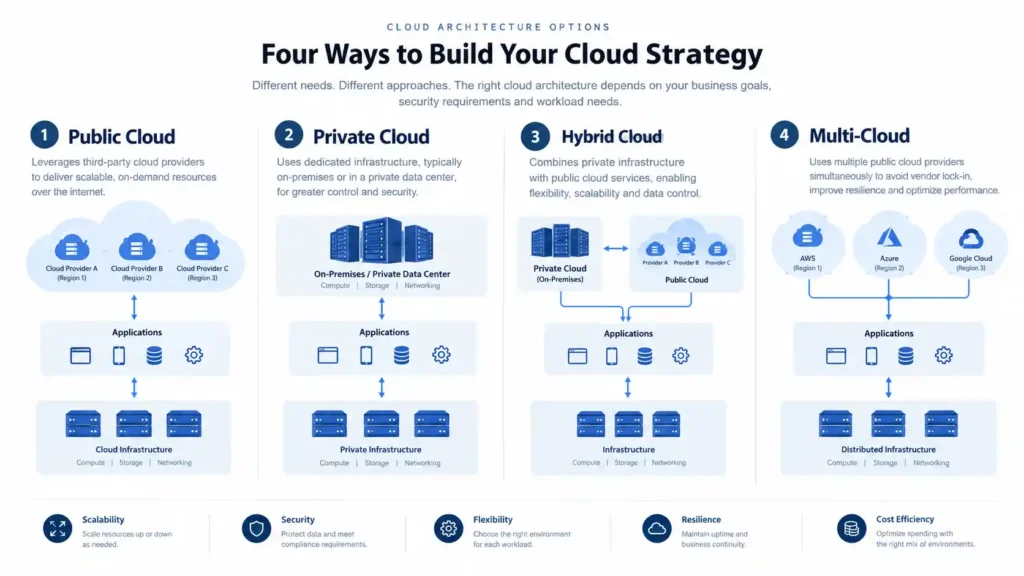
Public, Private, Hybrid, and Multi-Cloud: What’s the Difference
Public cloud means renting computing resources from a third-party provider (AWS, Azure, Google Cloud) that also serves other customers on shared infrastructure. Private cloud means dedicated infrastructure — either on-premises or hosted — used exclusively by one organization, typically chosen for stricter compliance or data-control needs. Hybrid cloud combines the two, keeping some workloads private while running others on public cloud. Multi-cloud means deliberately using more than one public cloud provider, often to avoid depending entirely on a single vendor. Recent industry survey data puts the majority of enterprises in a hybrid or multi-cloud posture rather than committed to a single provider — a pattern covered in more detail in the vendor lock-in section below.
IaaS vs. PaaS vs. SaaS Explained
These three categories describe how much of the technical stack the provider manages for you. Infrastructure-as-a-Service (IaaS) gives you raw computing resources — virtual servers, storage, networking — and you manage everything built on top. Platform-as-a-Service (PaaS) adds a managed environment for building and deploying applications, handling the underlying infrastructure so developers can focus on code. Software-as-a-Service (SaaS) is the most complete: a fully built, ready-to-use application, like Salesforce or Google Workspace, where the provider manages everything. Most businesses use some mix of all three, often without thinking of it in these terms.
Cloud vs. Edge Computing: When Each Makes Sense
Cloud computing centralizes processing in large, distant data centers; edge computing processes data closer to where it’s generated — on a local device or nearby server — to reduce latency. As our automation news page covers in the context of AI-powered quality inspection cameras, edge computing matters when a task can’t tolerate the delay of a round trip to a distant data center. For most everyday business applications, though, centralized cloud computing remains the simpler, more cost-effective default — edge computing is a targeted solution for a specific latency problem, not a general replacement for cloud infrastructure.
This same latency problem shows up directly in automation — a real-world example is covered in our Drovenio Automation News guide, where AI-powered quality inspection cameras can’t afford the round trip to a distant data center.
Major Cloud Providers Compared

AWS: Market Position and Strengths
Amazon Web Services remains the largest cloud infrastructure provider by revenue, holding roughly 28–30% of the global market as of mid-2026, according to Synergy Research Group’s quarterly tracking. Its scale advantage comes from being first to market and offering the broadest range of services, which makes it a common default for companies that want the widest possible toolset, even if that breadth can also mean a steeper learning curve.
Microsoft Azure: Market Position and Strengths
Microsoft Azure holds the second-largest share, generally tracked between 20–25% depending on the measurement methodology, and has posted some of the fastest sustained growth among the major providers — Synergy Research reported Azure growing around 40% year-over-year for multiple consecutive quarters in 2026. Azure’s clearest advantage is deep integration with Microsoft 365 and other Microsoft enterprise tools, making it a natural fit for organizations already standardized on that ecosystem.
Google Cloud and the Smaller Players: Oracle Cloud, IBM Cloud, Alibaba Cloud
Google Cloud sits third at roughly 13–15% market share but has posted the fastest growth of the major providers — Synergy Research tracked Google Cloud revenue accelerating from 63% to 82% year-over-year growth in a single reporting period in 2026, crossing $24 billion in quarterly revenue. Together, AWS, Azure, and Google Cloud — the “Big Three” — control roughly 63–67% of the global cloud infrastructure market. Beyond them, Oracle Cloud has carved out a position particularly strong in database-heavy enterprise workloads, IBM Cloud focuses on hybrid cloud and enterprise clients with existing IBM relationships, Alibaba Cloud holds a dominant position specifically within the Chinese and broader Asia-Pacific market, and a newer category of “neocloud” providers (including CoreWeave and others) has grown quickly by specializing specifically in AI/GPU computing capacity rather than general-purpose cloud services.
| Provider | Global Market Share (2026) | Strongest For | Fastest Growth |
| AWS | ~28–30% | Broadest service catalog, first-mover ecosystem | Slowest of the Big Three, still growing |
| Microsoft Azure | ~20–25% | Microsoft 365 / enterprise ecosystem integration | ~40% YoY, sustained multiple quarters |
| Google Cloud | ~13–15% | Data analytics, AI/ML tooling (Vertex AI) | Fastest of the Big Three, 63–82% YoY |
| Oracle Cloud | Niche | Database-heavy enterprise workloads | Strong in enterprise migration deals |
| IBM Cloud | Niche | Hybrid cloud, existing IBM enterprise clients | Steady, enterprise-focused |
| Alibaba Cloud | Regional leader | China / Asia-Pacific market dominance | Strong regionally, limited elsewhere |
How to Choose a Provider for Your Business
For most small and mid-size businesses, the deciding factor isn’t which provider is “best” in the abstract — it’s which one fits your existing tools and team’s expertise. Already running on Microsoft 365? Azure integration will likely save real setup time. Building on open-source tools with a technically flexible team? AWS’s breadth may serve you better. Heavy on data analytics or already using Google Workspace? Google Cloud’s tooling tends to fit naturally. The market-share numbers above matter less for a single business’s decision than they might seem — they’re a signal of overall market direction, not a personal recommendation.
Is Cloud Computing Worth It for a Small Business Specifically?
Pay-as-you-go pricing has made cloud infrastructure genuinely accessible below the enterprise level — a solo developer or five-person startup can run production infrastructure on the same platforms as a Fortune 500 company, paying only for what they actually use rather than committing to expensive hardware upfront. The calculus changes as a business scales: a small business with predictable, modest traffic may find a simple managed hosting or PaaS option more cost-effective and easier to manage than the full flexibility (and complexity) of raw IaaS on a major provider. The right starting point is usually the simplest option that meets today’s need, not the most powerful one available.
Cloud Computing and the AI Infrastructure Boom
How AI Demand Is Reshaping Cloud Capacity and Pricing

The connection between AI and cloud computing isn’t abstract — it’s the single biggest driver of cloud market growth right now. Synergy Research Group reported that global enterprise spending on cloud infrastructure passed $143 billion in the second quarter of 2026 alone, a 43% year-over-year growth rate — the highest in eight years, marking eleven consecutive quarters of accelerating growth, which Synergy attributes directly to generative AI demand. AI-related workloads now account for a meaningfully growing share of total cloud spending, and that demand is part of why cloud capacity and pricing have shifted noticeably over the past two years: more of every provider’s infrastructure investment is going toward the specialized computing power AI models require.
The AI hardware and inference-cost trends covered in our Drovenio AI News guide aren’t separate from the cloud story — they directly shape what providers charge for the AI services covered here.
AWS Bedrock, Azure AI Foundry, and Google Vertex AI
Each major provider now offers a dedicated platform for building and running AI applications on their infrastructure: AWS Bedrock gives developers access to a range of foundation models through a single managed service, Azure AI Foundry offers similar capability tightly integrated with Microsoft’s broader AI and enterprise tools, and Google Vertex AI provides comparable functionality built around Google’s own models and infrastructure.
These platforms are where the AI trends covered on our AI news page actually get deployed at the infrastructure level — a business piloting an AI agent, as described in our automation and AI coverage, is very likely running it through one of these three services whether or not that’s visible to the end user.
Before committing budget to any one AI platform, our Drovenio Tech Reviews guide offers a reusable framework for evaluating vendor claims and comparisons like these.
How This Connects to Drovenio’s AI News Coverage
The AI hardware and inference-cost trends discussed on our AI news page aren’t separate from the cloud story — they’re the same story from a different angle. Chip supply and inference costs, covered there, directly shape what AWS, Azure, and Google Cloud charge for AI services here, and cloud capacity constraints are part of why AI feature pricing has moved as much as it has over the past year. Understanding one side without the other leaves a real gap in the picture.
Cloud Costs, FinOps, and Migration Realities
What Cloud Migration Actually Costs

Migration cost depends heavily on what you’re moving and from where. Shifting a handful of applications with modern architecture to the cloud might run a small business a few thousand dollars in setup and consulting time. Migrating a legacy system built on decades-old infrastructure — the kind still common in manufacturing, healthcare, and finance — is a different order of project entirely, often requiring months of planning, temporary parallel infrastructure while the migration happens, and specialized consulting that can run well into six figures for a mid-size company. The gap between those two scenarios is exactly why “how much does cloud migration cost” doesn’t have a single honest answer — it depends entirely on what you’re starting from.
Why Cloud Bills Spiral: An Introduction to FinOps

FinOps is the discipline that emerged specifically because cloud bills have a habit of running away from teams that don’t actively manage them. Pay-as-you-go pricing is flexible, but that same flexibility means costs can climb quietly — a developer spins up a test environment and forgets to shut it down, a storage bucket accumulates data no one’s cleaning up, an application scales resources automatically during a traffic spike and never scales back down. None of these individually looks alarming on a daily bill. Added up over months, they’re a common reason cloud costs end up well above what a business budgeted going in. FinOps practices — regular cost reviews, tagging resources by team or project so spending is traceable, and setting automated alerts before a bill spikes — exist to catch this before it becomes a budget crisis rather than after.
Expert Insight: “The businesses that get surprised by their cloud bill are almost always the ones treating it like a fixed subscription,” a cloud infrastructure consultant told us. “It’s not a subscription. It’s a utility bill — it moves with usage, and if nobody’s watching the meter, it’s going to climb. The fix isn’t complicated; it’s just a habit most teams haven’t built yet: check the bill monthly, know what’s driving it, and kill what you’re not using.”
Avoiding Vendor Lock-In with a Multi-Cloud Strategy
Vendor lock-in happens when a business builds so deeply on one provider’s specific tools and services that switching becomes prohibitively expensive or technically difficult — even if a competitor offers better pricing or features later. It’s a real tradeoff against the convenience of going all-in on one provider’s ecosystem, not a reason to avoid commitment altogether. A practical middle ground many organizations land on: build core applications with portable, widely supported technology where possible, and reserve provider-specific advanced features for workloads where the benefit clearly outweighs the lock-in risk. Full multi-cloud — deliberately splitting workloads across two or more providers — adds real operational complexity and usually only makes sense once a business is large enough to justify the extra management overhead.
Cloud Security, Reliability, and Outages
Cloud Security Basics: Shared Responsibility Model
Clouds providers operate under what’s known as the shared responsibility model: the provider secures the underlying infrastructure — physical data centers, network hardware, the virtualization layer — while the customer is responsible for securing what they build on top of it, including access controls, data encryption choices, and application-level security.
This distinction matters because a fair number of cloud security incidents trace back not to the provider failing at their part, but to a customer misconfiguring something on their end — an exposed storage bucket, an overly permissive access setting — that was always their responsibility to lock down.
Understanding this division of responsibility matters even more given how many cloud security incidents trace back to a customer-side misconfiguration rather than a provider failure — a theme covered in more depth in our Drovenio Cybersecurity News guide.
Data Residency and Compliance in the Cloud
Data residency requirements — rules about which country or region data must physically stay in — increasingly shape cloud architecture decisions, particularly for businesses operating under GDPR or serving customers in specific jurisdictions. All three major providers offer region-specific data centers precisely to address this, letting a business choose to keep customer data within, say, the EU or a specific country. Getting this wrong isn’t just a technical inconvenience; it can be a genuine compliance violation with real financial consequences.
Why Cloud Outages Happen and What They Mean for Your Business

Major cloud outages are rarer than the headlines might suggest, but when they happen, the impact is outsized precisely because so much of the internet runs on a small number of providers.
A useful real-world illustration: AWS’s US-EAST-1 region — one of its oldest and most heavily used — has been the source of some of the industry’s most disruptive outages over the years, each time taking down a wide range of unrelated consumer apps, banking services, and business tools that all happened to depend on that single region, simply because it’s a common default choice for customers setting up infrastructure without thinking specifically about regional redundancy.
Common causes include configuration errors during routine updates, cascading failures where one system’s problem overloads a backup system, and, less often, physical infrastructure issues at a specific data center. The practical takeaway for any business relying on cloud infrastructure: build for the outage you hope never happens, not just the normal day, which is exactly what the disaster recovery planning covered later in this guide addresses.
Expert Insight: “Nobody budgets for downtime until they’ve lived through it once,” a cloud infrastructure consultant told us. “The clients who take disaster recovery seriously almost always have a specific outage story behind that decision. My advice is to skip that painful lesson — assume the outage is coming, and build the fallback before you need it, not after.”
Case Study Section — Cloud Decisions in Practice
Case Study 1: A Small Business Migration That Went Over Budget
A 30-person logistics company budgeted a fixed amount to migrate its order-management system to the cloud, based on a vendor’s initial estimate that assumed a relatively clean, modern codebase. Once migration began, the team discovered the existing system depended on several years-old integrations that weren’t documented anywhere and had to be rebuilt rather than simply moved. The project ran well past its original budget and timeline. The company’s after-action review pointed to a specific, avoidable gap: no one had done a proper technical audit of the existing system’s dependencies before pricing the migration. The lesson lines up with the FinOps and cost sections above — the sticker-price estimate for a migration is only as good as the discovery work that went into it.
Case Study 2: A Company’s Response to a Major Provider Outage
A mid-size e-commerce retailer relying entirely on a single cloud provider experienced several hours of downtime during a regional outage at that provider, during which the company’s checkout system was completely unavailable. In the aftermath, the company didn’t switch providers — the outage was an isolated incident, not a pattern — but it did invest in a basic disaster recovery setup: critical customer-facing systems now fail over to a secondary region within the same provider, rather than depending entirely on a single location. The fix wasn’t full multi-cloud, which the team judged as more complexity than the situation warranted; it was a more modest, achievable step that addressed the specific failure mode that had actually occurred.
Case Study 3: An SMB Scaling AI Features Using Cloud AI Services
A small customer-support software company added an AI-powered response-drafting feature to its product using one of the major providers’ managed AI platforms rather than building and hosting its own AI infrastructure. The managed approach meant the company avoided the upfront cost and expertise required to run AI models directly, but it also meant its feature’s cost and performance were now tied to that provider’s pricing and capacity — a tradeoff the team weighed deliberately going in, rather than one they discovered after the fact. As AI-related cloud spending continues rising industry-wide, this build-versus-rent decision is becoming a standard part of how smaller companies plan AI features, not just larger enterprises.
Expert Tips Section — Choosing and Managing Cloud Infrastructure
A Checklist for Evaluating a Cloud Provider
- Confirm which of your existing tools and systems integrate natively with the provider, versus requiring custom work
- Ask for the provider’s published uptime track record, not just their SLA promise
- Check what data residency and compliance certifications are available in the regions you need
- Get a real cost estimate based on your actual expected usage, not a generic starting price
- Confirm what happens to your data and access if you decide to leave — export options, contract terms, exit costs
How to Avoid Common Cloud Cost Overruns
Set up billing alerts before you need them, not after a surprise invoice arrives. Tag every resource by team or project so spending is traceable to a specific owner, not a mystery line item. Review unused or idle resources on a regular schedule — a monthly calendar reminder catches most of the “forgot to shut it down” waste before it compounds into a real cost.
Questions to Ask Before Migrating a Legacy System to the Cloud
What undocumented integrations or dependencies exist that nobody’s mapped yet? What’s the realistic cost if the migration takes twice as long as estimated — is there a budget buffer, or does the project stall? Who’s responsible for the system during the transition period when parts of it are old infrastructure and parts are new? Case Study 1 above is a direct illustration of what happens when these questions go unasked.
Building a Basic Disaster Recovery Plan
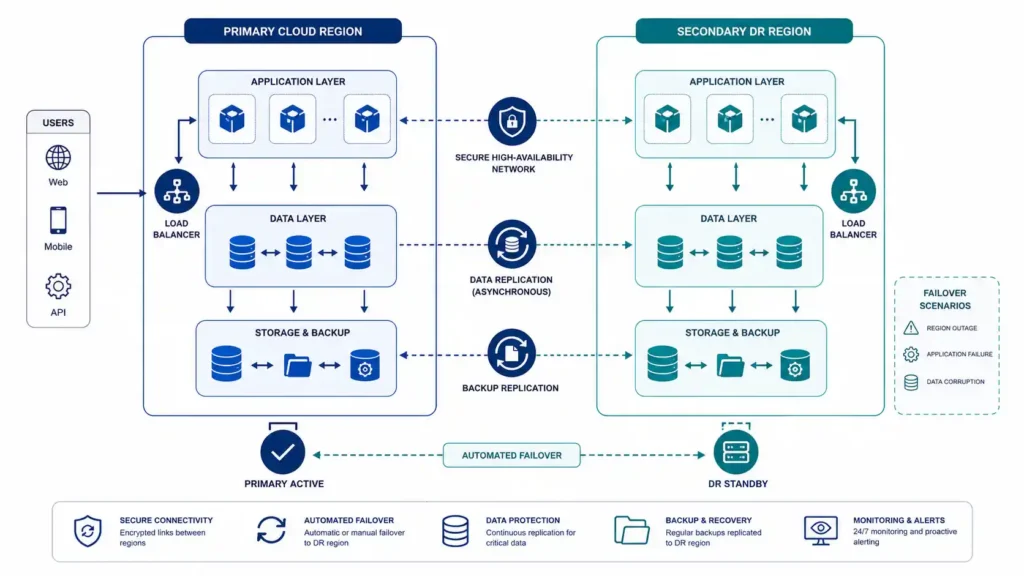
At minimum, know which systems are truly critical to keep running versus which can tolerate downtime, back up critical data to a separate region or provider rather than only within the same infrastructure that might fail together, and actually test the recovery process before you need it — a disaster recovery plan that’s never been tested is a plan built on assumptions, not evidence. Two terms worth knowing when discussing this with a provider or consultant: Recovery Time Objective (RTO), how quickly a system needs to be back online, and Recovery Point Objective (RPO), how much recent data you can afford to lose if a failure happens right before a backup. Defining both numbers explicitly turns “we should have a disaster recovery plan” into something an engineer can actually build against.
Cloud Computing Careers and Sustainability
In-Demand Cloud Skills and Certifications
Cloud engineering and architecture roles remain in strong demand as businesses continue migrating and scaling infrastructure, with provider-specific certifications — AWS Certified Solutions Architect, Microsoft Azure Fundamentals and Associate-level certifications, Google Cloud’s Professional Cloud Architect — serving as a common, verifiable entry point for both career-changers and IT professionals adding cloud skills to their existing background. FinOps-specific certification has also emerged as its own credential category, reflecting how central cost management has become to running cloud infrastructure well.
Cloud Data Centers and Energy Use
Our automation news page touches on the energy cost of AI infrastructure in passing — cloud data centers are the other half of that same story. As AI-driven cloud demand accelerates, so does data center energy consumption, enough that it’s become a factor in regional power grid planning in areas with heavy data center concentration. Major providers have made public commitments around renewable energy sourcing and efficiency, with real variation in how far along each one actually is — a detail worth asking about directly if sustainability factors into your provider decision, rather than taking a marketing page’s claims at face value.
FAQ
It’s an editorial platform covering cloud computing trends and providers — not a cloud service itself, and not affiliated with AWS, Azure, Google Cloud, or any other provider it discusses.
No. This content has no financial or partnership relationship with any provider mentioned, and doesn’t sell or resell cloud infrastructure.
There’s no single best provider — AWS leads on breadth and market share, Azure fits naturally with existing Microsoft environments, and Google Cloud has posted the fastest growth and strong data/AI tooling. Oracle Cloud and IBM Cloud remain strong niche choices for database-heavy or hybrid enterprise workloads. The right choice depends on your existing tools, team expertise, and budget more than any provider’s overall market position or Gartner ranking.
A cloud model where the provider automatically manages and scales the underlying servers, and you’re billed based on actual usage rather than reserved capacity — useful for workloads with unpredictable or spiky traffic, since you’re not paying for idle infrastructure between spikes.
It’s generally accessible and worthwhile even at small scale, thanks to pay-as-you-go pricing that avoids large upfront hardware costs. The right approach is usually starting with the simplest option that meets current needs — a managed PaaS or SaaS product rather than raw infrastructure — and scaling up in complexity only as the business actually requires it.
Conclusion
Cloud computing rarely gets treated as its own story, but it’s the layer everything else in this technology cluster is actually built on — the AI tools covered on our AI news page and the automation platforms covered on our automation news page all run on infrastructure with real providers, real pricing pressure, and real failure modes worth understanding directly. The market itself is moving fast: AI demand has pushed cloud spending growth to its highest rate in eight years, and that pressure is reshaping pricing and capacity in ways that ripple down to every AI feature and automated workflow built on top of it, whether the underlying architecture is a simple SaaS subscription, a serverless deployment, or a full Kubernetes-managed container fleet running across multiple regions and a content delivery network.
The businesses that navigate this well tend to do a few unglamorous things consistently: choosing a provider based on genuine fit rather than headline market share or a Gartner quadrant position, budgeting for migration with a real technical audit rather than a vendor’s optimistic estimate, watching the cloud bill actively instead of treating it as fixed, and having a tested disaster recovery plan for the outage they hope never comes. That same grounded approach is worth bringing to cloud computing news itself — look for sourced data, named providers, and honest acknowledgment of costs and failure modes alongside the genuine benefits. For the AI and automation trends running on top of this infrastructure, see our Drovenio AI News and Drovenio Automation News pages, or return to the full Drovenio Latest Technology News pillar guide for the complete picture.

Introduction
Search “business automation,” and you’ll find a lot of confident numbers: automation cuts costs 30 to 60 percent, saves 40 to 60 percent of manual task time, and will grow into a $400-billion-plus market within a couple of years. What you won’t often find alongside those numbers is the other half of the picture — that Gartner has reported roughly half of RPA projects fail to scale past their pilot stage, and that Gartner separately projects more than 40% of agentic AI projects will be canceled by the end of 2027 over unclear business value or inadequate risk controls. Drovenio automation news genuinely works. It also genuinely fails, more often than the marketing copy suggests, and understanding why is the difference between a project that pays for itself and one that quietly gets abandoned six months in.
This page covers what’s actually happening in business automation in 2026 — the real difference between RPA, AI-enhanced automation, and the “hyperautomation” combination of the two, the tools businesses are actually using, honest cost and failure data, and how to tell whether a process is genuinely ready for automation before you spend money finding out the hard way. For the broader technology picture beyond automation AI, cloud, and cybersecurity trends see our complete Drovenio Latest Technology News guide.
What Is Drovenio Automation News?
Platform Overview: Editorial Content, No Vendor Affiliation
Drovenio automation news is editorial content, not automation software, and not a reseller of it. This page has no financial relationship, affiliate arrangement, or partnership with any automation vendor mentioned below — a disclosure worth stating plainly, because a fair amount of automation content online reads like a product pitch without saying so.
Clearing Up the Confusion: Is Droven.io an Automation Software Company?
Searches for “Drovenio automation” sometimes turn up content that describes an automation product or feature list attached to the Drovenio name. Based on publicly available information, there’s no independently verifiable software product operating under that name — no pricing page, no support documentation, no company registration details of the kind a real SaaS vendor typically publishes. What appears to have happened is that some lower-effort content treated an editorial brand name as a product name, and other pages copied the framing without checking. Treat any page claiming to sell “Drovenio automation software” with real skepticism.
Who This Automation Coverage Is Built For
This content is written for people evaluating whether and how to automate part of their work — small business owners with a handful of repetitive tasks, operations managers scoping a larger RPA rollout, and marketers stitching together no-code tools — without assuming a technical or IT background going in.
RPA vs. AI Automation vs. Hyperautomation — What’s the Difference
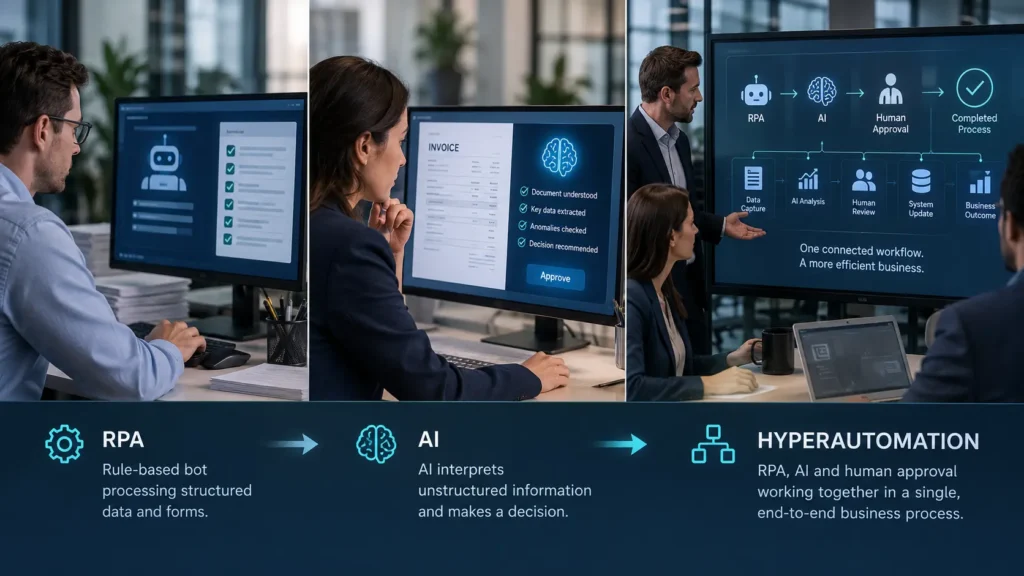
Robotic Process Automation (RPA): Rule-Based and Structured
RPA uses software bots to follow fixed, rule-based steps — copying data between systems, filling in forms, moving files — the same way every time. It’s reliable for structured, repetitive, low-variation work, and it’s the technology behind most “automation” success stories from the last decade. Its limitation is baked into its design: RPA can’t handle a process that doesn’t follow the script, which is exactly why, as covered below, so many RPA projects stall once real-world exceptions start piling up.
AI-Enhanced Automation: Where Agentic AI Comes In
AI-enhanced automation adds judgment to the rule-following. Instead of a bot that breaks when it hits an invoice formatted slightly differently than expected, an AI-enhanced system can read the document, understand what it’s looking at, and decide how to handle it — closer to how our AI news page describes agentic AI operating in other business contexts. The tradeoff is that AI-enhanced automation is harder to fully predict and requires more oversight than a rigid RPA bot, precisely because it’s making judgment calls rather than following a fixed script.
Hyperautomation: How RPA and AI Are Converging in 2026
“Hyperautomation” is the industry term for combining RPA, AI, and process orchestration into a single automated workflow rather than treating them as separate tools — RPA handling the structured parts of a process, AI handling the parts that need judgment, and a coordination layer routing work between them and to humans when needed. Gartner has consistently listed some version of this convergence among its top strategic technology trends, and it’s the direction most serious enterprise automation vendors have moved their product roadmaps toward.
How This Connects to Drovenio’s AI News Coverage
Automation and AI are frequently covered as separate topics, but by 2026 they’re increasingly the same story told from different angles: agentic AI (covered on our AI news page) is, in practice, automation with more autonomy and judgment built in. If you’re evaluating “AI agents” for your business, you’re evaluating an automation decision — the governance and piloting advice covered in our Drovenio AI News guide applies directly here too.
Popular Automation Tools Compared

No-Code Tools for Small Teams: Zapier, Make, n8n
Zapier and Make (formerly Integromat) are visual, no-code platforms built for connecting apps — triggering an action in one tool based on an event in another — without writing code, and they’re the common starting point for small businesses automating things like lead capture or notification workflows. n8n offers similar functionality with an open-source option, appealing to teams with some technical capacity who want more control over hosting and customization than the fully-hosted alternatives allow.
Enterprise RPA Platforms: UiPath, Automation Anywhere, Power Automate
UiPath and Automation Anywhere are established enterprise RPA platforms built for larger-scale, higher-volume automation across legacy systems that don’t have modern APIs to connect to — a common reality in large organizations with older core software. Microsoft’s Power Automate sits closer to the no-code tools in accessibility but benefits from deep integration with Microsoft 365, making it a natural fit for organizations already standardized on that ecosystem. Enterprises with heavier integration needs also frequently pair these platforms with dedicated tools like Workato or Tray.ai for connecting complex, custom system architectures that off-the-shelf connectors don’t cover.
Marketing and CRM-Focused Automation: GoHighLevel and Similar Tools
GoHighLevel and comparable platforms focus specifically on marketing and customer relationship workflows — lead follow-up, appointment scheduling, campaign sequencing — bundling automation with CRM functionality rather than acting as a general-purpose connector between arbitrary apps. These tools trade the broad flexibility of a Zapier or Make for depth in one specific business function, which is usually the right tradeoff for a team whose automation needs are almost entirely sales-and-marketing focused.
| Best for | Setup complexity | Typical cost range | Needs a developer? | |
| Zapier / Make | Small teams connecting popular apps | Low | Free–$100s/mo | No |
| n8n | Technical teams wanting self-hosted control | Medium | Free (self-hosted) or paid cloud tiers | Helpful, not required |
| UiPath / Automation Anywhere | Enterprise, high-volume, legacy systems | High | Licensing + implementation, $$$$ | Yes |
| Power Automate | Microsoft 365-standardized organizations | Low–Medium | Bundled/tiered with Microsoft 365 | No |
| GoHighLevel | Marketing/CRM-specific workflows | Low | Flat monthly subscription | No |
How to Match a Tool to Your Business Size and Technical Skill Level
As a rough guide: no-code tools like Zapier, Make, or n8n suit small teams automating a handful of workflows without dedicated technical staff. Enterprise RPA platforms make sense once you’re automating high-volume, structured work across systems that don’t offer modern integrations — and once you have, or plan to hire, someone to maintain the bots. Marketing-specific platforms make sense when the automation need is narrowly focused on customer communication rather than general business operations. Picking the more powerful, more expensive tool before you’ve outgrown the simpler one is a common, avoidable cost.
Is Automation Actually Worth It? Real Costs and ROI Data
What Independent Research Actually Shows About Automation ROI
The honest picture is mixed, and that’s worth saying directly rather than repeating only the favorable half. Gartner has reported that roughly 50% of RPA projects fail to scale beyond their pilot stage, largely due to rigid architectures that can’t handle real-world process variation, and Deloitte research attributes about 37% of RPA failures specifically to poor change management rather than the technology itself.
On the AI-automation side, Gartner’s own 2025 research projects that more than 40% of agentic AI projects will be canceled by the end of 2027 due to escalating costs, unclear business value, or inadequate risk controls. Gartner has separately noted that of the thousands of vendors marketing “agentic AI,” only about 130 offer genuinely agentic capability rather than a rebranded chatbot or existing RPA tool — a practice the firm calls “agent washing.” None of this means automation doesn’t work; it means the failure rate is real, well-documented, and worth planning around rather than ignoring.
Expert Insight: “Every client comes to me with the success-story numbers already memorized,” an automation implementation consultant told us. “Nobody arrives having read the Gartner data on scaling failure. That imbalance is itself a risk factor — if leadership only knows the upside, the pilot gets rushed to a company-wide rollout before anyone’s stress-tested it against a messy real-world week.”
Realistic Cost Breakdown: No-Code vs. Enterprise RPA
No-code tools typically run from free or a few dollars per month for small-volume use up to a few hundred dollars monthly as usage scales, with most of the cost being the platform subscription itself. Enterprise RPA is a different order of cost entirely — licensing, implementation consulting, and a maintenance function are all typically necessary, since bots built against enterprise systems tend to break when those systems change, and someone needs to be responsible for fixing them. That maintenance burden is a real, ongoing cost that’s frequently left out of upfront automation cost estimates.
Why Automation Projects Fail (and How Often)
The most commonly cited reasons across the research above cluster around a few patterns: automating a process that has too much natural variation for rigid rules to handle, insufficient change management (staff resistance or unclear communication about how automation affects their roles), and underestimating the ongoing maintenance a bot requires once the systems around it inevitably change. None of these are exotic failure modes — they’re avoidable with the right planning, which is exactly what the sections below cover.
How to Know If a Process Is Ready for Automation
Process Mining and Discovery: Finding What’s Worth Automating

Process mining tools — Celonis is the best-known dedicated platform, alongside process-mining modules built into UiPath — analyze how a task actually gets done, pulling from system logs to show the real steps, exceptions, and bottlenecks in a workflow, rather than the idealized version described in a training manual. It’s a step most businesses skip.
A multi-country survey of 400 senior decision-makers across the US, UK, France, and Germany found that while 70% of US respondents considered process understanding essential to RPA success, only around 31% were actually using process mining tools to build that understanding before automating — and 60% acknowledged their real-world processes involved exceptions and deviations from the documented rules, not the clean, consistent version assumed at project kickoff.
That gap between what decision-makers say matters and what teams actually do before automating helps explain why so many projects end up automating the wrong thing, or automating a broken process faster rather than fixing it.
Signs a Process Is a Good Automation Candidate
A process is generally a strong automation candidate when it’s high-volume, follows a consistent, describable set of steps most of the time, involves moving or transforming data between systems, and produces a clear, measurable output (time saved, errors reduced) you can track after deployment. Invoice processing, data entry between systems, and routine notification workflows are common examples that meet this bar.
Signs You Should Fix the Process First
A process is a poor automation candidate when it’s full of undocumented exceptions, when different people currently do it differently for reasons no one can clearly explain, or when the process itself is widely acknowledged as inefficient rather than just manual. Automating a broken process doesn’t fix it — it just makes the broken version run faster and harder to change later, since now a bot depends on it working exactly as automated.
Automation Governance, Security, and Maintenance
Audit Trails and Compliance for Automated Workflows
Any automated workflow touching financial data, customer records, or regulated information should log what it did and when, in a form that can be reviewed after the fact — the automated equivalent of knowing who approved what and when in a manual process. This isn’t optional in regulated industries: SOX compliance requires auditable controls over financial-reporting processes, and GDPR imposes its own requirements around how automated systems handle personal data. Auditors and regulators increasingly expect an automated decision to be as traceable as a human one.
Access Control: What Should a Bot Be Allowed to Touch?

A common, avoidable mistake is granting an automation bot broader system access than the specific task requires, because it’s faster to set up than scoping permissions carefully.
A frequently cited real-world pattern: a bot built to update customer shipping addresses gets provisioned with full read-write access to the entire customer database, because that was the fastest path to launch — meaning a single misconfigured workflow, or one compromised credential, can now touch billing and payment data it was never meant to reach.
Scoping a bot’s access tightly isn’t just an automation best practice — it’s the same identity and access management (IAM) principle covered in more depth in our Drovenio Cybersecurity News guide.
Automation Debt: Why Workflows Break Over Time
“Automation debt” describes the accumulating fragility of bots built against systems that keep changing underneath them — a vendor updates a login page, a spreadsheet template gets a new column, and a bot that worked perfectly for months suddenly fails silently. Forrester research on RPA costs has found maintenance can account for a majority of ongoing RPA expense over a project’s life, which is exactly why budgeting for automation as a one-time setup cost, rather than an ongoing maintained system, is one of the more consistent reasons projects quietly become expensive to keep alive.
This kind of ongoing maintenance cost isn’t unique to automation — it echoes the same cost-overrun and FinOps challenges businesses face with cloud infrastructure, covered in our Drovenio Cloud Computing News guide.
Case Study Section — Automation in Practice
Case Study 1: A Small Business Automating Invoice Processing
A 15-person accounting firm used a no-code tool to automate pulling vendor invoices from a shared email inbox into their bookkeeping software, a task that previously consumed a staff member’s time most mornings. The initial setup handled standard PDF invoices well but failed silently on scanned, handwritten, or unusually formatted ones — the automation simply skipped them without flagging the miss, and a few went unpaid past their due date before anyone noticed. The fix was straightforward once identified: adding a fallback step that flagged anything the automation couldn’t confidently process for manual review, rather than assuming success by default. After that change, the firm reported reclaiming most of the time previously spent on the task, with the flagged-exception rate low enough to manage easily. The case illustrates a theme from the sections above: automation without a clear “what happens when this fails” plan tends to fail invisibly, not loudly.
Case Study 2: An Enterprise RPA Rollout Scaled Back After Integration Failures
A mid-size insurance company deployed RPA bots to process claims across several legacy systems, following a successful small pilot. Scaling the pilot company-wide exposed exactly the pattern Gartner’s research describes: the pilot’s processes were more consistent than the full range of claim types across the whole organization, and the rigid bots couldn’t handle the variation once expanded. Rather than continuing to expand a struggling rollout, the company paused, brought in process mining to understand where variation was actually occurring, and redesigned the automation to route higher-variation claims to human review while keeping the straightforward majority automated. The scaled-back version delivered less dramatic headline numbers than the original pilot projected, but it was stable and sustainable — a more honest outcome than most automation case studies report, and arguably a more useful one to learn from.
Case Study 3: A Marketing Team Combining Automation with Agentic AI
A marketing team at a mid-size retailer used a combination of a no-code automation tool and an AI writing assistant to handle first-draft social media responses and routine customer inquiries, escalating anything requiring judgment or a policy exception to a human. Rather than deploying it company-wide immediately, the team piloted it on one channel for a month, tracked how often the AI’s draft responses needed heavy editing, and used that data to refine which types of inquiries the system handled versus escalated. This hyperautomation-style combination — RPA-style triggers routing to AI-generated drafts, with human sign-off — reflects the direction most of the tools discussed above are heading, and the deliberate, measured piloting approach is consistent with what the research earlier in this guide suggests separates successful automation from stalled projects.
Expert Tips Section — Evaluating and Adopting Automation
A Checklist for Choosing an Automation Tool
- Confirm the tool can actually integrate with your specific existing systems, not just popular ones in general.
- Ask what happens when the automation encounters something it wasn’t built to handle
- Check whether ongoing maintenance requires technical staff or is manageable by the team already using the tool.
- Ask for the tool’s actual uptime and error-handling track record, not just its feature list.
- Confirm what data the tool has access to and how that data is stored or used.
How to Pilot an Automation Before Scaling Company-Wide

Start with one process, in one department, with a clearly defined success metric decided before the pilot begins — not evaluated retroactively based on whatever numbers look good afterward. Run it long enough to hit real-world exceptions, not just the clean cases from the first week. Only expand once the pilot has handled genuine edge cases successfully, which is the exact step the scaled-back case study above skipped the first time around.
Expert Insight: “The number one thing I tell clients before any RPA project,” an automation implementation consultant told us, “is to automate the process you actually have, not the process you wish you had. If nobody can tell me, in detail, what the exceptions look like today, we’re not ready to automate — we’re ready to go find out what those exceptions are first.”
Questions to Ask Before Trusting an Automation ROI Statistic
Ask whether the source is independent research or a vendor with something to sell. Ask whether the figure reflects an average across many deployments or a single best-case example. Whether the number accounts for ongoing maintenance cost, or only the initial time savings — a distinction that, as covered above, materially changes the real return.
Budgeting for Setup, Integration, and Ongoing Maintenance
Beyond the tool’s licensing cost, budget for initial integration work, a change-management plan for affected staff, and — critically, given how much of RPA’s real cost is maintenance — an ongoing budget line for keeping bots working as connected systems change, rather than treating automation as a project with a defined end date.
FAQ
It’s an editorial platform covering automation trends and tools — not a piece of software, and not affiliated with any automation vendor it discusses.
No. This content has no financial or partnership relationship with any tool mentioned, including Zapier, Make, n8n, UiPath, Automation Anywhere, Power Automate, or GoHighLevel.
RPA (Robotic Process Automation) follows fixed, rule-based steps and struggles when a process varies from the script. AI-enhanced automation — the kind increasingly built into tools like UiPath and Power Automate — can interpret unstructured input and make judgment calls, at the cost of being harder to fully predict.
The combination of RPA, AI, and workflow orchestration into a single system — using rule-based automation for structured tasks and AI for the parts requiring judgment, rather than treating them as separate tools. It’s one of the clearest examples of digital transformation moving from buzzword to applied practice.
No-code tools typically range from free to a few hundred dollars monthly depending on usage. Enterprise RPA platforms like UiPath or Automation Anywhere involve licensing, implementation, and — often underestimated — ongoing maintenance, which research indicates can account for a majority of total RPA cost over time.
For no-code tools like Zapier, Make, or n8n, generally no — a non-technical team member can typically manage basic workflows. Enterprise RPA and complex integrations usually benefit from dedicated technical support, particularly for ongoing maintenance.
Conclusion
The honest version of the automation story isn’t “automate everything and save 50%.” It’s narrower and more useful than that: automation reliably pays off on high-volume, well-understood, consistent processes, and reliably struggles on processes with more variation and exception-handling than the tool was built for — which is precisely what the roughly 50% RPA scaling-failure figure from Gartner’s research reflects. The businesses that avoid becoming part of that statistic tend to do the unglamorous things well: running process mining or discovery before committing to a tool, understanding the actual process before automating it, piloting narrowly before scaling, budgeting for the automation debt that accumulates as connected systems change, and staying skeptical of any ROI number — or any vendor claiming “agentic” capability — that doesn’t show its work.
Whether that means a small no-code workflow in Zapier or Make, a full RPA deployment on UiPath or Automation Anywhere, or a hyperautomation setup blending both with AI judgment layered in, the underlying discipline is the same: treat automation as an ongoing system to govern and maintain, not a one-time project with a finish line. That same skepticism is worth applying to automation news itself, including this page — look for sourced data, named tools, and honest acknowledgment of failure rates alongside success stories. For the broader AI picture behind much of today’s automation, see our Drovenio AI News page, or return to the full Drovenio Latest Technology News pillar guide for the complete digital transformation landscape.
Pingback: Drovenio AI News: 2026 Agentic AI Trends & Insights
Pingback: Drovenio Cloud Computing News: What's Real in 2026
Pingback: Drovenio Cybersecurity News: 2026 Threats & Defenses