Software & Apps
Enterprise Compensation Management: The Complete Guide


Introduction
Ask any Total Rewards leader at a 5,000-person company what keeps them up at night, and “the spreadsheet” comes up more often than you’d expect. If you’re a CHRO, Total Rewards leader, or compensation analyst reading this, you already know why: enterprise pay is a moving target across a dozen countries, three currencies, shifting pay transparency laws, and a workforce that expects to understand exactly how their pay is determined. Spreadsheets aren’t built for that.
Enterprise compensation management is the strategy, process, and technology an organization uses to plan, administer, and govern how it pays its people — base salary, bonuses, equity, and benefits — at scale and in compliance with the laws of every jurisdiction it operates in. It’s different from basic payroll (which executes payments) and different from generic HR software (which manages people data). Compensation management sits in between: it’s where pay strategy becomes pay decisions.
This guide walks through what enterprise compensation management actually involves, how the software category works, how to choose a platform, and — because most guides stop at theory — real case studies, practical tips from practitioners, and the compliance details that tend to get glossed over. If you’re evaluating a system, building a comp strategy from scratch, or just trying to understand why this function has become so central to HR, this is written for you.
What Is Enterprise Compensation Management?
At its core, enterprise compensation management is the discipline of designing, planning, and administering pay in a way that’s competitive, equitable, compliant, and financially sustainable — at a scale where manual processes break down.
The word “enterprise” isn’t just a size qualifier. It signals a specific set of problems: multiple business units with different compensation philosophies, employees in countries with wildly different labor laws, currencies that fluctuate mid-cycle, and a compensation committee or board that expects clean, auditable reporting. A 50-person startup can run its comp cycle in a spreadsheet. A global enterprise with 20,000 employees across 15 countries genuinely cannot — not without significant risk.
Compensation Management vs. Total Rewards vs. Payroll — Key Differences
These three terms get used interchangeably, and that’s a mistake worth correcting.
Payroll is execution — it calculates and distributes what employees are owed, handles tax withholding, and ensures people get paid on time. It’s downstream of compensation decisions, not the place where those decisions are made.
Total rewards is the broader umbrella. It includes compensation, but also benefits, well-being programs, recognition, and career development — everything an employee gets in exchange for their work, tangible and intangible.
Compensation management is the narrower, more operational layer: the planning, budgeting, benchmarking, and administration of pay itself. It’s where a manager decides a 4% merit increase for one employee and 7% for another, where bonus pools get allocated, and where equity grants get modeled against vesting schedules.
Enterprise compensation management software typically lives at this middle layer, though the better platforms increasingly pull in total rewards statements and benefits data to give employees a complete picture.
Why “Enterprise” Changes the Complexity
A few things change dramatically once an organization crosses into enterprise territory:
- Data volume and structure. Thousands of employees mapped to job codes, levels, and pay grades that need to stay consistent across departments and geographies.
- Regulatory exposure. What’s optional in a 200-person company — like formal pay equity audits — becomes a legal requirement in many jurisdictions once headcount and geography expand.
- Approval chains. A single comp decision might route through a manager, a second-level approver, HR business partner, and finance before it’s final.
- Currency and market data. Benchmarking a role in Frankfurt against local market data looks nothing like benchmarking the same role in Austin.
None of this is insurmountable, but it explains why “enterprise compensation management” is treated as its own category rather than a feature bolted onto general HR software.
Core Components (Base Pay, Variable Pay, Equity, Benefits)
Every enterprise compensation strategy is built from four core levers:
- Base salary — the fixed, recurring pay tied to a role and level.
- Variable pay — bonuses, commissions, and incentives tied to individual, team, or company performance.
- Equity compensation — stock options, RSUs, or other ownership stakes, particularly common in tech and post-IPO companies.
- Benefits — health insurance, retirement contributions, and other non-cash elements that factor into total compensation value.
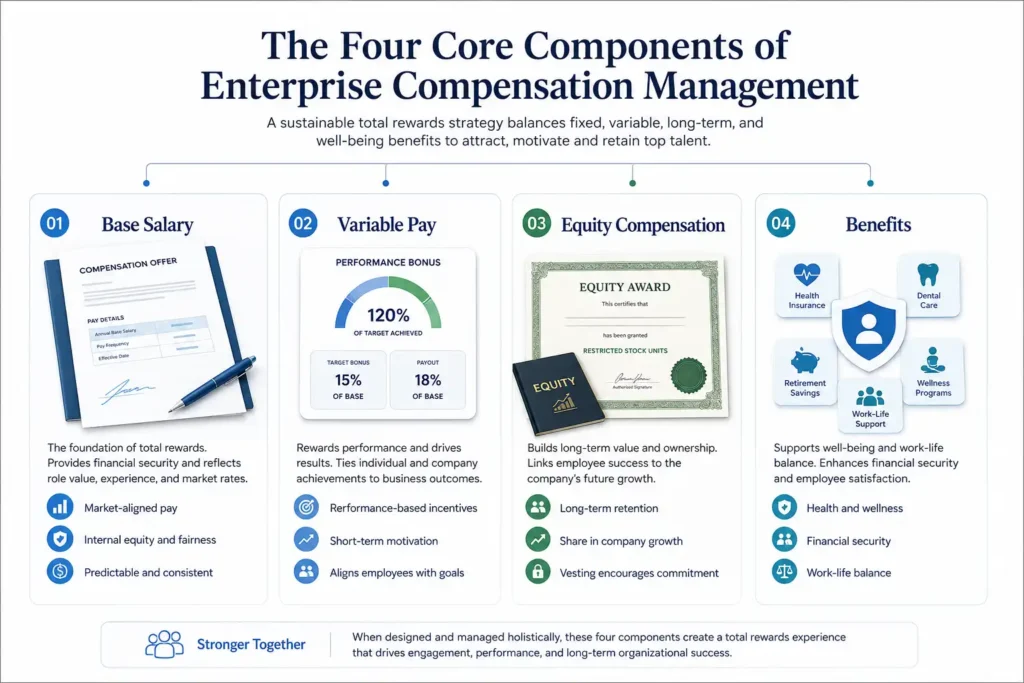
How an organization weights these four levers is a direct reflection of its compensation philosophy — which we’ll get into shortly.
Why Enterprises Need Dedicated Compensation Management
It’s worth being blunt about this: most organizations don’t adopt dedicated compensation management software because it’s trendy. They adopt it because the alternative started failing visibly.
The Hidden Cost of Spreadsheet-Based Comp Planning
Spreadsheets scale poorly, and the failure mode is rarely dramatic — it’s quiet. A broken VLOOKUP formula understates a bonus pool by $40,000. A manager works from a stale version of the file because version control lives in someone’s email inbox. A compensation analyst spends three of the six weeks in a comp cycle just reconciling data instead of analyzing it.
The real cost isn’t the spreadsheet itself — it’s the opportunity cost. Comp teams at large organizations routinely report spending 60-70% of cycle time on data wrangling and reconciliation rather than strategic decisions like identifying flight-risk employees who are underpaid relative to market.
Compliance Risk in a Multi-Jurisdiction Workforce
This is where spreadsheets stop being merely inefficient and start being genuinely risky. Pay transparency legislation has expanded quickly — Colorado, California, New York, Washington, and Illinois all have some form of pay disclosure requirement in the U.S., and the EU Pay Transparency Directive introduces reporting obligations for companies operating across member states, with enforcement dates that vary by country but generally phase in through 2026.
Manually tracking which pay bands must be disclosed in which job posting, in which state, updated for which role — across hundreds of open requisitions — is not a spreadsheet problem. It’s a systems problem. Non-compliance isn’t hypothetical; it results in fines, litigation exposure, and reputational damage that shows up in employer review sites and recruiting funnels.
Retention, Pay Equity, and the Business Case for Investment
Here’s the piece that often gets buried under compliance talk: compensation management, done well, is a retention lever. Employees who believe their pay is fair — both externally competitive and internally equitable — are measurably less likely to leave. Conversely, unexplained pay gaps, once discovered (and in an era of pay transparency, they will be discovered), erode trust fast.
The business case isn’t just “avoid a fine.” It’s: reduce unplanned attrition, shorten the compensation cycle from six weeks to two, and give managers defensible, data-backed reasoning for every pay decision they make.
Core Components of an Enterprise Compensation Strategy
Software supports strategy — it doesn’t replace it. Before evaluating any platform, it helps to understand the strategic building blocks it needs to support.
Compensation Philosophy and Market Positioning
Every enterprise compensation strategy starts with a positioning decision, usually expressed as lead, lag, or match against the market:
- Lead — pay above market median to win talent in competitive roles or markets.
- Match — pay at market median, a common default for stable, less competitive roles.
- Lag — pay below market, sometimes offset by stronger equity or benefits, common in early-stage or budget-constrained contexts.
Most enterprises don’t pick one strategy company-wide — they segment it. A fintech company might lead on engineering talent while matching on operations roles, for instance. This philosophy becomes the reference point every future pay decision gets measured against.
Job Architecture and Leveling Frameworks
Job architecture is the skeleton that makes consistent compensation possible. It’s the framework of job families, levels, and career ladders that lets an organization say, with confidence, that a “Senior Product Manager, L5” in Chicago and a “Senior Product Manager, L5” in London are comparable roles, even if the pay ranges differ by local market.
Without clean job architecture, benchmarking is guesswork, and internal equity comparisons become unreliable. This is also, not coincidentally, the single most common data-quality problem organizations run into when migrating to a new compensation platform — inconsistent or duplicated job codes.
Pay Bands, Compa-Ratio, and Range Penetration
Once job architecture is in place, each role gets mapped to a pay band — a minimum, midpoint, and maximum for that level in that market.
Compa-ratio is the metric used to see where an individual’s pay sits within that band.
How to calculate compa-ratio:
- Find the midpoint of the employee’s assigned salary range.
- Divide the employee’s actual salary by that midpoint.
- Multiply by 100 to express it as a percentage.
Compa-ratio = Employee’s Salary ÷ Midpoint of Salary Range
Example: If the midpoint of a role’s salary range is $100,000, and an employee earns $92,000, their compa-ratio is 0.92 (or 92%). A compa-ratio of 1.0 means the employee sits exactly at the market midpoint; below 1.0 means they’re paid below midpoint, and above 1.0 means they’re paid above it.
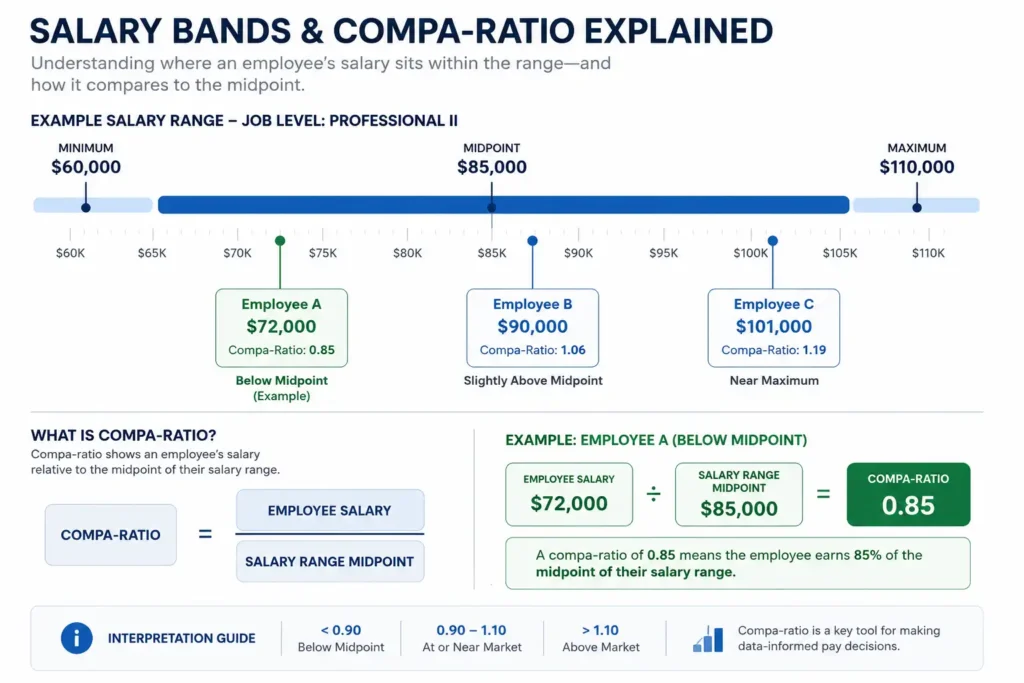
Range penetration measures the same idea slightly differently — how far into the band (from minimum to maximum) an employee’s pay falls, expressed as a percentage. These two metrics together are the backbone of merit matrix design: they tell a manager not just how much of a raise someone deserves based on performance, but how much room they have left to move within their band before hitting the ceiling.
Some enterprises use broadbanding instead of narrow, numerous pay grades — consolidating many traditional salary grades into a smaller number of wider bands. This trades precise grade-to-grade differentiation for administrative flexibility, and tends to suit organizations with flatter, less hierarchical structures.
Merit Increases, Bonus Pools, and Incentive Design
A merit matrix typically cross-references performance rating against compa-ratio or range penetration to recommend an increase percentage. An employee rated “exceeds expectations” but already sitting near the top of their range might get a smaller percentage increase than an equally-rated employee lower in their band — because there’s more room to move.
Bonus pools work differently: they’re usually funded as a percentage of payroll or tied to company/business unit performance, then allocated down through the org based on individual or team results. Getting this allocation right — and defensible — is one of the most common reasons enterprises move off spreadsheets, since pool math across dozens of business units multiplies fast.
Executive and Sales Compensation as Distinct Sub-Categories
Two categories deserve separate mention because they don’t fit the standard merit-cycle model:
Executive compensation is typically governed by the compensation committee, tied to long-term incentive plans, equity vesting, and increasingly subject to public disclosure requirements (proxy statements, for public companies). It moves on a different governance track entirely.
Sales compensation, often called incentive compensation management (ICM), is commission-driven and calculated on a different cadence — sometimes monthly or even real-time — based on quota attainment, deal size, or other performance triggers. Many organizations run ICM on separate, specialized software from their broader compensation management platform, though the two increasingly integrate.
How Enterprise Compensation Management Software Works
Once the strategy is defined, software is what makes it executable at scale — automating the workflows, calculations, and approvals that would otherwise consume weeks of manual effort.

Key Features to Look For
Not all compensation management platforms are built the same, but the strongest enterprise tools generally share a core feature set:
- Workflow automation — routing merit and bonus recommendations through multi-level approval chains automatically.
- Budget modeling — real-time visibility into how allocated increases track against the approved budget, before the cycle closes.
- Manager self-service — letting managers make and justify pay recommendations directly in-platform, with guardrails.
- Compensation dashboards and reporting — for HR and finance to monitor cycle progress, spot outliers, and prepare board-level reporting.
- Pay equity analytics — flagging statistically significant pay gaps by gender, ethnicity, or other protected classes before they become compliance issues.
- Total rewards statements — generating personalized breakdowns of an employee’s full compensation package, often a strong retention communication tool.
HRIS, Payroll, and ERP Integration Requirements
A compensation platform that doesn’t talk to the rest of the HR tech stack creates the exact reconciliation burden it’s meant to eliminate. The critical integrations are:
- HRIS (Workday, SAP SuccessFactors, Oracle HCM, etc.) — for employee, job, and org data.
- Payroll systems — to ensure approved compensation changes actually get executed correctly and on schedule.
- ERP/finance systems — for budget data and headcount cost modeling.
Most enterprise-grade platforms offer pre-built connectors for major HRIS providers. Worth scrutinizing during evaluation: how real-time that sync actually is. Daily batch syncs versus true API-based real-time updates make a meaningful difference during an active comp cycle, when org changes — promotions, terminations, transfers — happen constantly.
Compensation benchmarking accuracy also depends on data sourcing outside the platform itself. Most enterprises pull market data from survey providers like Radford, Mercer, or Willis Towers Watson, either through direct integration or manual import — the platform’s own analytics are only as good as the benchmarking data feeding them.
Security and Compliance Standards
Compensation data is among the most sensitive data an enterprise holds. At minimum, evaluate any platform against:
- SOC 2 Type II certification, at minimum
- GDPR compliance, if operating in or processing data from the EU
- SOX audit trail requirements, for public companies, where every compensation change needs a documented, immutable record of who approved what and when
- Role-based access controls, ensuring managers only see compensation data for their direct reports, not the broader org
Build vs. Buy: When Spreadsheets Still Make Sense
To be fair to spreadsheets: for very small companies, or for a single, simple annual merit cycle with fewer than a few hundred employees and minimal geographic complexity, a well-built spreadsheet template can still work. The tipping point tends to arrive when any of the following become true: multiple currencies, formal pay equity reporting obligations, more than roughly 500-1,000 employees, or a compensation cycle that involves more than two levels of manager approval. Past that point, the manual reconciliation cost consistently outweighs the cost of a platform.
Choosing the Right Compensation Management Platform
With the “why” and “how” established, the practical question becomes: how do you actually evaluate and select a system without the process dragging on for a year?
Evaluation Criteria and Weighted Scorecard
A disciplined evaluation weighs criteria rather than relying on vendor demos alone. A practical scorecard typically weights:
| Criteria | Suggested Weight |
| HRIS/payroll integration depth | 20% |
| Pay equity & compliance features | 20% |
| Configurability (workflows, bands, currencies) | 15% |
| Manager/employee user experience | 15% |
| Implementation timeline & support | 15% |
| Total cost of ownership | 15% |
Score each vendor against this rubric with your actual stakeholders — HR, finance, IT/security, and a sample of manager end-users — rather than leaving the decision solely to procurement or HR leadership in isolation.
Total Cost of Ownership: Licensing, Implementation, and Hidden Costs
The sticker price on a per-employee-per-month license is rarely the full cost. Budget conversations should also account for:
- Implementation and configuration fees — often a substantial one-time cost, especially for complex job architectures
- Data migration costs — cleaning and mapping legacy data, frequently underestimated
- Integration costs — connecting to existing HRIS/payroll, sometimes billed separately
- Training and change management — particularly for manager adoption
- Ongoing support tiers — some vendors charge extra for dedicated support during active cycles
Implementation Timeline: What to Expect at Enterprise Scale
For a true enterprise deployment — multiple business units, multiple countries, integration with an existing HRIS — a realistic implementation timeline runs 4 to 9 months from contract signature to first live comp cycle, not the 6-8 weeks sometimes implied in sales conversations. The bulk of that time is rarely spent configuring the software itself; it’s spent cleaning and validating job architecture and compensation data before it ever touches the new platform.
Vendor Comparison Table
| Platform | Best Fit | Notable Strength |
| Workday Compensation | Large enterprises already on Workday HCM | Deep native HRIS integration |
| SAP SuccessFactors | Large, complex global organizations | Strong multi-country/currency support |
| Beqom | Enterprises with complex incentive structures | Flexible configuration for hybrid comp models |
| CompTrak | Mid-to-large enterprises, finance-heavy comp teams | Strong compensation statement generation |
| Payfactors / Payscale | Organizations prioritizing benchmarking data | Deep market pricing data integration |
(Pricing varies significantly by employee count, modules selected, and negotiated terms — request current quotes directly from vendors rather than relying on published list pricing, which is rarely current.)
Pay Equity and Global Compliance

If there’s one area where enterprises get caught flat-footed, it’s here. Compensation strategy can be well-designed and still be legally exposed if compliance is treated as an afterthought.
Understanding Pay Transparency Laws by Region
Pay transparency isn’t one law — it’s a patchwork, and it’s expanding every year.
United States
States including Colorado, California, New York, and Washington now require salary ranges in job postings, though specifics differ — some apply only to in-state roles, others to any posting a remote-eligible resident could apply to.
Colorado’s Equal Pay for Equal Work Act, one of the earliest and broadest, requires employers to disclose compensation and benefits in every job posting and prohibits using a candidate’s pay history to set their wage. It’s worth grounding this in real enforcement data rather than treating it as a hypothetical risk: the Colorado Division of Labor Standards and Statistics maintains a public log of assessed penalties, and outcomes vary widely — some violations are resolved with the fine waived after correction, while confirmed violations have drawn assessed penalties in the tens of thousands of dollars. That range is a useful data point for compliance budgeting: the risk isn’t usually catastrophic on a single posting, but it compounds fast across an enterprise running hundreds of open requisitions simultaneously without a systematic review process.
European Union
The EU Pay Transparency Directive sets a transposition deadline of 7 June 2026 for member states, with formal gender pay gap reporting obligations for employers with 100 or more workers beginning in 2027. Its core requirements include disclosing pay ranges to job seekers before interview, banning salary history questions, giving employees the right to request average pay levels by sex, and requiring remediation where an unjustified gender pay gap of 5% or more is identified.
This is not a single EU-wide standard rolling out on one date — member states are transposing the directive at different speeds and with different scope. Belgium and the Czech Republic have already implemented partial requirements ahead of the full deadline, while other member states have signaled delays. Enterprises with EU headcount need a country-by-country tracker, not a single “EU compliant” checkbox.
UK and Canada
The UK has required gender pay gap reporting for employers with 250+ employees for several years, with annual publication obligations. Canada’s federal Pay Equity Act imposes proactive audit obligations rather than complaint-driven enforcement — a meaningfully different compliance posture than most U.S. employers are used to, where the burden of initiating action typically sits with the employee or a responding regulator rather than the employer.
Practical takeaway: Don’t try to build a single global compensation communication policy. Build a compliance matrix by jurisdiction, keep it current, and assign clear, named ownership for tracking legislative changes — this is an ongoing role, not a one-time project. With the EU deadline landing in mid-2026, any enterprise with EU headcount that hasn’t started a readiness assessment is already behind the typical implementation runway most advisory firms recommend.
Expert recommendation: Compensation and total rewards practitioners consistently flag the same early step for EU readiness: don’t start with the legal text, start with job architecture. You can’t produce a defensible gender pay gap report or comparator data if roles aren’t consistently categorized first. Treat job architecture cleanup as the prerequisite project, not a parallel one.
Running a Pay Equity Audit — Step-by-Step Process
A defensible pay equity audit generally follows this sequence:
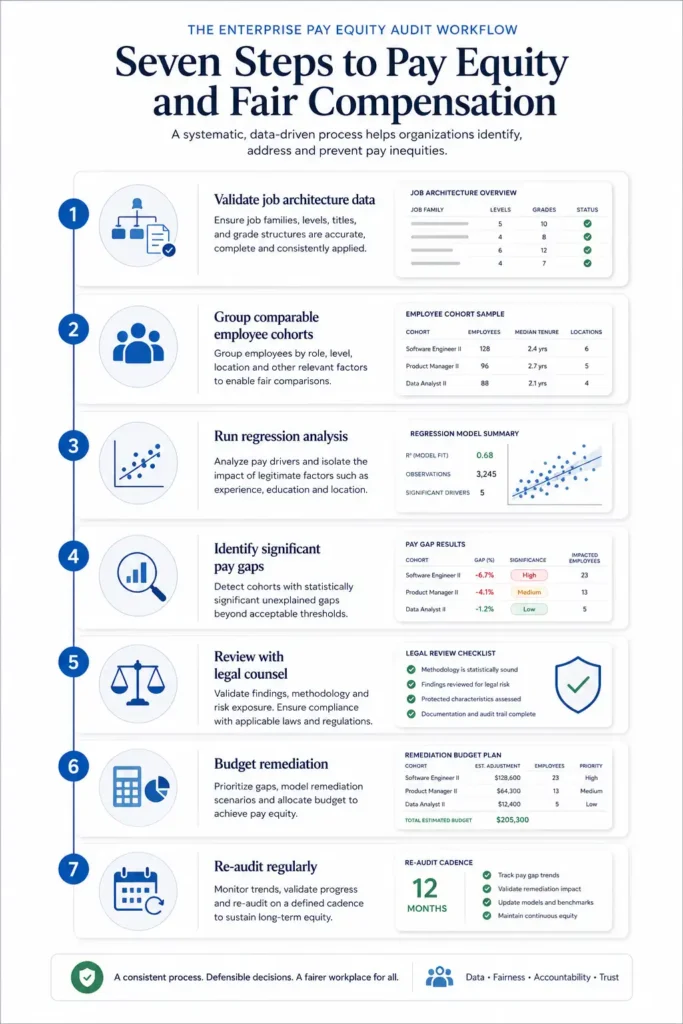
- Clean and validate job architecture data. Pay comparisons are only meaningful if job codes and levels are consistent across the organization.
- Group employees into comparable cohorts — same job family, level, and location, since pay ranges legitimately differ by geography.
- Run a regression analysis controlling for legitimate factors like tenure, performance rating, and experience.
- Identify statistically significant gaps that remain after controlling for those factors — this is the signal that matters, not raw averages.
- Loop in legal counsel before remediation decisions, since audit findings can carry legal discoverability implications depending on jurisdiction.
- Budget and execute remediation, typically phased over one or more comp cycles rather than all at once.
- Re-audit on a recurring cadence — annually at minimum, more frequently in fast-growing organizations.
Budgeting for Pay Equity Remediation
This is the step organizations most often underestimate. A meaningful pay equity gap discovered across a few thousand employees can require a remediation budget in the high six or low seven figures, depending on severity. The practical approach most comp leaders take is phasing remediation across two or three cycles rather than requesting the full amount at once — it’s a more realistic ask for finance, and it still demonstrates good-faith, documented progress if the audit is ever scrutinized externally.
DEI and Compensation Analytics
Beyond legally mandated pay equity work, many enterprises track broader representation-adjusted pay analytics — not to set quotas, but to catch patterns that a straightforward gender or ethnicity regression might miss, such as gaps concentrated in specific job families or geographic offices rather than spread evenly across the org.
Managing the Annual Compensation Cycle at Scale
Strategy and compliance set the boundaries. The comp cycle is where the actual work happens — and where most of the operational pain shows up.
Pre-Cycle Planning: Budget Allocation and Guardrails
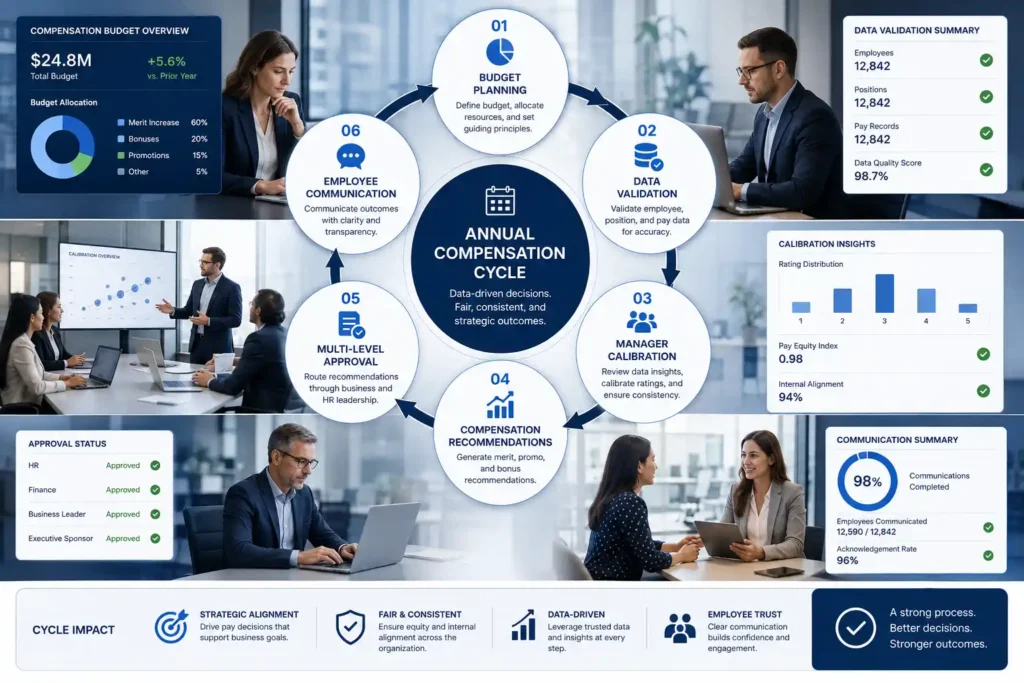
Before a single manager makes a recommendation, the budget needs to be set and distributed. This typically means finance approves an overall increased budget (often expressed as a percentage of total payroll), which then gets allocated down to business units — sometimes evenly, sometimes weighted by business unit performance or historical attrition risk.
Guardrails matter here more than most teams realize. Without a system enforcing them, it’s common for early-approving managers to spend disproportionately from a shared bonus pool, leaving later approvers with less room — even if their team’s performance justifies more. Platforms that show real-time budget consumption as recommendations are entered prevent this specific failure mode.
Manager Calibration — Reducing Rating Bias
Calibration sessions, where managers within a department compare performance ratings before compensation decisions are finalized, exist specifically to catch a well-documented problem: individual managers rate inconsistently. One manager’s “meets expectations” is another’s “exceeds expectations,” and left unchecked, this bleeds directly into inequitable pay outcomes.
Practical tip: run calibration before comp recommendations are entered into the system, not after. Trying to walk back a compensation number a manager has already committed to creates far more friction than adjusting a performance rating pre-decision.
Expert recommendation: Experienced compensation leaders generally advise capping calibration sessions at manageable group sizes — roughly 8-12 managers per session works well in practice. Larger groups tend to produce surface-level agreement without genuinely surfacing rating inconsistencies, because there isn’t enough time per case for real debate.
Communicating Compensation Changes to Employees
This is consistently underweighted in comp cycle planning, and it shows. A well-justified pay decision communicated poorly generates almost as much dissatisfaction as an unjustified one communicated well. The organizations that handle this best generally do three things: give managers a simple, consistent talking-point framework rather than leaving them to improvise; separate the compensation conversation from the performance review conversation by at least a few days so employees process one before the other; and provide a total rewards statement alongside the raw number, so employees see bonus, equity, and benefits value — not just a base salary percentage that can look small in isolation.
Off-Cycle and Market Adjustment Requests
Not every pay decision fits neatly into the annual cycle. Retention counters, promotion-driven adjustments, and market corrections (a role suddenly becomes hard to hire for) all require an off-cycle process. Enterprises that handle this well have a lightweight, clearly-owned approval workflow for these requests — distinct from the full annual cycle process — so managers aren’t tempted to route urgent retention counters through informal channels like email approvals that never make it into the system of record.
Compensation Management for Complex Workforces
Standard merit-cycle thinking assumes a fairly homogenous, full-time, single-country workforce. Most enterprises don’t actually look like that anymore.
Global and Multi-Currency Compensation
Running compensation across multiple currencies introduces a question that trips up a lot of organizations: do you lock exchange rates at the start of the cycle, or let them float? Locking rates gives budget predictability but can create real discrepancies if a currency moves significantly mid-cycle — something that became a very live issue for multinational employers during periods of high currency volatility. Most mature comp functions lock rates for planning purposes but review actuals against a defined tolerance band before final approval.
Hybrid/Remote Employees and Geographic Pay Zones
Geographic pay differentiation — sometimes called location-based pay — became a much bigger operational question with the shift to remote work. The practical approaches enterprises use tend to fall into a few camps: pure market-based (pay reflects the employee’s actual location), zone-based (a limited number of tiers, e.g., Tier 1/2/3 cities, rather than infinite granularity), or national-average (a single band regardless of location within a country). Zone-based approaches tend to strike the best balance between fairness and administrative complexity — pure market-based pricing requires constant re-benchmarking as employees relocate.
Contingent and Frontline Workforce Compensation
Contractors, gig workers, and hourly frontline employees are frequently managed in entirely separate systems from salaried compensation — which creates blind spots. An enterprise with a large contingent workforce needs visibility into total labor cost and equity considerations across both populations, even if the systems and pay mechanics differ (hourly wage compliance, overtime rules, and contractor classification laws all add their own layer of complexity here).
Post-IPO Equity and RSU Vesting Complexity
Once a company goes public, equity compensation stops being a relatively simple grant-and-vest structure. Enterprises need to model vesting schedules against stock price volatility, handle tax withholding at vest (which differs by country), and often manage refresh grants for retention alongside original grants — all while ensuring compensation statements clearly communicate current equity value, which can fluctuate significantly between when an offer is made and when shares actually vest.
Emerging Approaches: Skills-Based Pay and AI-Assisted Recommendations
Two shifts are changing how enterprise compensation teams think about pay architecture beyond the traditional job-based model.
Skills-based pay ties compensation more directly to demonstrated skills and capabilities rather than solely to job title and level. This is gaining traction in fast-moving technical fields where the traditional job architecture updates slower than the skills the market actually values — an organization might pay a premium for a specific in-demand certification or technical competency independent of formal title. It’s not a replacement for job architecture so much as a layer on top of it, and it introduces its own governance question: how do you verify and periodically re-validate that a skill premium is still warranted?
AI-assisted compensation recommendations are increasingly built into enterprise platforms — surfacing suggested merit increases based on performance data, market position, and flight-risk signals, rather than leaving every recommendation to unaided manager judgment. The practical caution here is one most experienced comp leaders raise unprompted: an AI-suggested number is a starting point for manager judgment, not a replacement for it, and any pay equity audit process needs to account for algorithmic recommendations the same way it accounts for manager decisions — a biased training dataset can just as easily produce a biased output.
Case Studies
The following are composite, illustrative scenarios reflecting common patterns observed across enterprise compensation implementations — not verbatim accounts of a single named company. They’re included to show how the frameworks above play out in practice, with realistic numbers and timelines drawn from typical enterprise engagements.

Case Study 1: Legacy-to-Platform Migration at Scale
A global industrial manufacturer with roughly 8,000 employees across 12 countries ran its annual comp cycle through a combination of Excel workbooks and email approvals for years. The breaking point came when a formula error in a regional bonus calculation wasn’t caught until after payouts had already been communicated to employees — requiring a corrective adjustment that damaged trust with the affected team.
Approach: The organization moved to an enterprise compensation platform integrated directly with their existing HRIS, with a phased six-month rollout: pilot in one region first, then expand.
Result: Cycle time dropped from roughly six weeks to just over two. Data reconciliation errors, previously a near-certainty each cycle, were effectively eliminated because the platform pulled job and salary data directly from the HRIS rather than relying on manually exported spreadsheets. Manager adoption was the slower win — full self-service usage took a second full cycle to reach consistent adoption, reinforcing that technology rollout and behavior change run on different timelines.
Case Study 2: M&A Compensation Harmonization
Following an acquisition, a mid-size software company needed to integrate the acquired company’s roughly 600 employees — who had an entirely different job leveling structure and, in several cases, meaningfully different pay for comparable roles — into its existing compensation framework.
Approach: Rather than forcing an immediate, single-cycle harmonization (which risked significant pay cuts or spikes for individuals), the company mapped the acquired company’s roles to its own job architecture first, identified gaps, and phased salary adjustments over three cycles, prioritizing the largest inequities first.
Result: Harmonization was substantially complete within 18 months, with no attrition spike attributable to the compensation transition — a result the company attributed directly to the phased approach and to over-communicating the plan with acquired employees early, rather than leaving them in uncertainty about how their pay would change.
Case Study 3: Pay Equity Remediation
A financial services firm with approximately 4,000 U.S.-based employees conducted a formal pay equity audit ahead of anticipated state-level disclosure requirements, expecting the exercise to be largely confirmatory.
Approach: The regression-based audit, controlling for tenure, performance, and role level, identified statistically significant unexplained pay gaps concentrated in a handful of job families — not evenly distributed across the organization, which made the remediation targeted rather than company-wide.
Result: The firm budgeted remediation across two cycles rather than attempting an immediate fix, closing the majority of identified gaps within the first year. Just as important as the pay adjustments themselves: the firm documented the audit methodology and remediation plan thoroughly, which mattered when the findings later needed to be defensible to both the board and legal counsel.
Expert Tips for Enterprise Compensation Success
A few patterns show up repeatedly among comp teams that run smooth cycles versus ones that don’t:
- Clean your job architecture before you migrate systems, not after. Migrating messy data into a new platform just gives you a faster way to make the same mistakes.
- Set budget guardrails before the cycle opens. Retroactively enforcing a budget after managers have already made informal promises to their teams is a lose-lose conversation.
- Run calibration before compensation decisions, not as a parallel or after-the-fact check. Rating consistency has to be settled first.
- Treat pay transparency compliance as an ongoing communications function, not a one-time legal review. Laws change, and someone needs explicit ownership of tracking that.
- Model cost-of-living and inflation impact on pay bands at least annually. Bands that go stale erode both external competitiveness and internal trust simultaneously.
- Loop in finance early, not at budget approval time. Comp planning is fundamentally a shared exercise between HR and FP&A — treating it as an HR-only process tends to produce budgets that get revised late in the cycle, which is disruptive for everyone involved.
How to Prove ROI on Compensation Management Investment
KPIs That Matter to the CFO
Comp leaders making the business case for platform investment tend to get more traction focusing on a small set of concrete, financial metrics rather than general efficiency claims:
- Cycle time reduction — hours or weeks saved per cycle, translated into loaded cost of comp team time
- Error rate — reconciliation errors caught before payout versus after (post-payout corrections carry real reputational and administrative cost)
- Unplanned regrettable attrition, particularly among employees flagged as below-market or high flight-risk
- Audit readiness — time required to produce a defensible compensation report on request, whether from a board, regulator, or legal team
Building the Business Case for Leadership
The strongest business cases pair a hard cost (headcount hours currently spent on manual reconciliation, quantified) with a risk exposure figure (potential compliance fine or litigation cost avoided) rather than leaning on either alone. Finance leaders respond better to “this reduces cycle time by X hours, worth $Y in comp team capacity, and reduces our compliance exposure in these five states” than to a purely qualitative pitch about efficiency or employee experience.
Frequently Asked Questions
It’s the strategy, process, and technology organizations use to plan, administer, and govern employee pay — base salary, bonuses, equity, and benefits — at scale, across multiple business units and jurisdictions, in compliance with relevant labor laws.
Compensation management generally covers the broader annual merit and bonus cycle across the workforce. ICM specifically handles commission-based sales compensation, often calculated on a different cadence and tied to quota attainment rather than annual performance ratings.
Pricing varies widely by employee count, modules selected, and implementation complexity, typically structured as per-employee-per-month licensing plus a separate implementation fee. Total cost of ownership, including migration and integration costs, is usually significantly higher than the license price alone suggests.
For a true enterprise deployment with multiple business units and countries, realistic timelines run 4 to 9 months from signature to first live cycle — most of that time spent on data cleanup and validation rather than software configuration.
Most enterprise-grade platforms offer pre-built connectors to major HRIS systems like Workday, SAP SuccessFactors, and Oracle HCM. The depth of that integration — real-time API sync versus daily batch updates — varies meaningfully between vendors and is worth testing directly during evaluation.
Conclusion
Enterprise compensation management isn’t really a software category — it’s the operational backbone that turns compensation philosophy into consistent, defensible pay decisions across a large, distributed workforce. The organizations that get this right treat it as a strategic function that sits at the intersection of HR, finance, and legal, not as an administrative task to be minimized.
The compliance landscape isn’t slowing down, employee expectations around pay transparency aren’t reversing, and the cost of getting it wrong — in fines, in attrition, in eroded trust — only grows with company size. Whether you’re evaluating a platform for the first time or reassessing one that’s stopped scaling with your organization, the fundamentals stay the same: clean job architecture, a clear compensation philosophy, defensible pay equity practices, and a system built to enforce all three without adding friction to the people actually doing the work.


Introduction
Search “best compensation management software” and you’ll find a dozen lists that all look suspiciously similar — the same six vendors, the same vague feature bullets, and not one of them tells you how they arrived at the ranking. That’s not a knock on the vendors. It’s a knock on the lists.
This guide takes a different approach. Instead of one flat ranking, it’s organized around the question that actually determines the right answer: what kind of buyer are you? A 15,000-employee manufacturer with operations in nine countries needs something fundamentally different from a 400-person software company running its first real compensation cycle. We’ve broken this down by company size and by use case; we’re upfront about how we evaluated each platform, and we’ve included the parts most “best of” content leaves out — realistic pricing structure, implementation timelines, and where each option tends to fall short.
If you want the deeper strategic and compliance context behind why this decision matters, our companion guide on enterprise compensation management covers that ground. This page is built to get you from “which vendors even do this” to a short, defensible list you can bring into your own evaluation process.
How We Ranked These Compensation Management Platforms
Transparency here matters more than it might seem. A ranking with no visible methodology is just an opinion dressed up as research, and it’s worth being direct about that before asking anyone to trust a list.
Our Evaluation Criteria and Weighting
Each platform below was assessed against the same criteria used in our enterprise compensation management evaluation scorecard: HRIS and payroll integration depth, pay equity and compliance features, configurability across workflows and currencies, manager and employee user experience, implementation timeline, total cost of ownership, and data security certifications (SOC 2 and ISO 27001 where relevant for global deployments). No single criterion dominates the ranking — a platform with excellent integrations but a painful implementation process won’t automatically outrank one that’s slightly less feature-rich but considerably easier to deploy.

A worked example of how this plays out in practice: imagine comparing a full-suite enterprise platform against a lighter mid-market tool for a 1,200-employee company operating in two countries. On integration depth and configurability, the enterprise platform scores higher — it simply does more. But on implementation timeline and total cost of ownership, the mid-market tool scores higher, since it can go live in weeks rather than months and doesn’t require dedicated implementation consultants. Weighted evenly across six criteria, these two platforms can land within a point of each other despite looking completely different on paper — which is exactly why “best” depends on which criteria matter most to your specific situation, not a single combined score.
What We Didn’t Consider
Worth stating plainly: this list isn’t influenced by vendor payment, affiliate arrangements, or sponsored placement. Where a vendor’s strengths and limitations are described, they reflect publicly available product information and general category positioning, not a paid partnership. If a platform looks strong in one section and weaker in another, that’s the point of an honest comparison rather than a marketing page.
How Rankings Differ by Company Size
This is the piece most competing lists skip entirely, and it’s the reason we’ve split recommendations into enterprise and mid-market sections rather than one combined list. A platform built for organizations with dedicated compensation analysts, complex approval chains, and multi-country payroll often introduces unnecessary complexity — and cost — for a smaller HR team running a single annual cycle. The reverse is also true: a lightweight, mid-market-friendly tool can genuinely struggle once an organization crosses into multi-currency, multi-entity territory. Matching platform complexity to organizational complexity matters more than chasing whichever vendor scores highest on paper.
Best Compensation Management Software at a Glance
| Platform | Best For | Pricing Model | Typical Implementation |
| Workday Compensation | Enterprises already on Workday HCM | Enterprise licensing, bundled with HCM suite | 4–9 months |
| SAP SuccessFactors | Large, complex global organizations | Enterprise licensing, modular | 4–9 months |
| Beqom | Enterprises with complex incentive structures | Custom enterprise pricing | 3–6 months |
| CompTrak | Finance-heavy enterprise comp teams | Custom enterprise pricing | 3–6 months |
| Payfactors / Payscale | Benchmarking-first organizations of most sizes | Tiered, per-employee | 1–3 months |
| ChartHop | Mid-market, people-analytics-forward teams | Tiered, per-employee | 4–8 weeks |
| HiBob | Mid-market, especially without dedicated comp staff | Tiered, per-employee | 4–8 weeks |
Pricing tiers and implementation timelines are directional estimates based on general market positioning — request current, company-specific quotes before budgeting.

Best Compensation Management Software for Enterprise
For organizations with complex approval chains, multi-country payroll, and dedicated compensation teams, the evaluation criteria shift toward integration depth and configurability over ease of setup.
Workday Compensation — Best for HRIS-Native Integration
Workday’s compensation module lives inside its broader HCM suite, which is its biggest structural advantage: for organizations already running Workday for core HR, the compensation data — job architecture, org structure, employee records — is already there, eliminating a category of integration work that standalone tools have to solve for. This tends to make it a strong default for large enterprises already invested in the Workday ecosystem, though it’s rarely the right starting point for an organization not already on Workday HCM, given the scale of that broader commitment.

Where it tends to fall short: organizations report that heavy customization of workflows can require specialized Workday configuration expertise, which adds to implementation cost and timeline beyond the software licensing itself.
SAP SuccessFactors — Best for Global, Multi-Currency Organizations
SuccessFactors has a long track record supporting large, geographically distributed workforces, and its compensation module reflects that — strong multi-currency and multi-country configuration options are a consistent strength cited by enterprise buyers. It tends to suit organizations where global complexity is the primary driver of platform choice, more than organizations prioritizing a lightweight or fast rollout.
Where it tends to fall short: the depth that makes it strong for global complexity can translate into a steeper learning curve for HR teams and a longer implementation runway than lighter-weight alternatives.
Beqom — Best for Complex Incentive and Sales Compensation Structures
Beqom differentiates itself with flexibility for organizations running hybrid compensation models — base pay, complex bonus structures, and sales incentive compensation managed within a single platform rather than bolted-together systems. This makes it a common shortlist entry for enterprises whose compensation structure doesn’t fit neatly into a standard merit-cycle model.
Where it tends to fall short: that flexibility comes with configuration complexity — organizations with simpler compensation structures may find the platform’s capability exceeds what they actually need, at a cost that reflects the added functionality.
Expert recommendation: Compensation leaders who’ve run enterprise vendor evaluations consistently flag the same mistake: shortlisting based on feature checklists alone, without weighting how much implementation and ongoing administrative overhead each feature actually adds. A platform that technically supports everything you might someday need isn’t automatically the right choice if your team doesn’t have the bandwidth to configure and maintain that depth.
Best Compensation Management Software for Mid-Market
Mid-market organizations — broadly, companies without a large dedicated compensation team, often running their first formal comp cycle software — tend to be better served by platforms that prioritize fast implementation and guided workflows over maximum configurability.

HiBob — Best for Companies Without Dedicated Comp Headcount
HiBob’s compensation tools are built into a broader HR platform aimed at growing companies, with an emphasis on guided workflows that don’t assume a dedicated compensation analyst is running the process. For a mid-market HR generalist managing compensation as one responsibility among many, that guided structure tends to reduce the learning curve significantly compared to enterprise-first platforms.
Where it tends to fall short: organizations that scale quickly into multi-country complexity sometimes find they outgrow the platform’s compensation depth faster than its core HR functionality, requiring a reassessment as they grow.
ChartHop — Best Value for Growing, Analytics-Forward Teams
ChartHop’s positioning around org design and people analytics extends naturally into compensation planning, giving growing companies visibility into compensation alongside headcount planning and org structure in one view — useful for HR teams that are simultaneously managing rapid organizational change and their first real compensation process.
Where it tends to fall short: as with most platforms built primarily for growth-stage companies, the depth of pay equity and compliance tooling tends to be lighter than purpose-built enterprise platforms, which matters more as an organization’s regulatory footprint expands.
Payfactors / Payscale — Fastest Path to Market Benchmarking
For organizations where the immediate priority is simply getting accurate, defensible market pay data — rather than a full workflow overhaul — Payscale’s benchmarking-first positioning tends to offer the fastest time-to-value. It’s a common choice for mid-market companies building out a compensation function for the first time and needing credible market data before anything else.
Where it tends to fall short: organizations that need deep merit-cycle workflow automation, not just benchmarking data, often find they need to pair it with a separate planning tool rather than relying on it as a complete solution.
Expert recommendation: For mid-market buyers specifically, practitioners who’ve been through this evaluation more than once tend to give the same advice: resist the pull toward enterprise-tier platforms just because they have the most recognizable name. The right question isn’t “what do the biggest companies use” — it’s “what can my team actually implement and maintain well, given our current headcount and expertise.” A platform your team can run confidently beats a more powerful one that sits half-configured.
Best Compensation Management Software by Use Case
Company size isn’t the only variable that matters. Some organizations have one specific, dominant requirement that should drive the shortlist more than general size-based fit.

Best for Pay Equity and Compliance
Organizations where pay equity reporting and audit-readiness are the primary driver — increasingly common as EU and U.S. state transparency laws expand — tend to be better served by platforms with pay equity analytics built in as a core feature rather than a bolt-on. Tools like Trusaic and PayAnalytics are built specifically around this use case, running statistical pay gap analysis as their primary function rather than a secondary module inside a broader compensation suite.
For organizations where compliance risk is the main concern, a purpose-built tool often surfaces issues more reliably than a general compensation platform’s equity add-on — which matters given real deadlines on the calendar: the EU Pay Transparency Directive requires member states to transpose it into national law by 7 June 2026, with formal gender pay gap reporting obligations for employers with 100+ workers beginning in 2027. Organizations with EU headcount evaluating platforms this year should weight pay equity capability more heavily than they might have two years ago.
Best for Sales Compensation (ICM)
Standard merit-cycle compensation software often handles commission-based sales compensation poorly, since sales comp usually runs on a different cadence — monthly or even real-time — tied to quota attainment rather than annual performance ratings. Dedicated incentive compensation management tools like Xactly and Varicent are purpose-built for this: modeling complex commission structures, handling real-time quota tracking, and managing plan changes mid-year without the workflow friction of forcing sales comp into an annual-cycle tool.
Best for Global, Multi-Currency Payroll
Beyond the enterprise-tier platforms already covered, organizations specifically prioritizing multi-currency and multi-country payroll integration — without necessarily needing full enterprise HCM scope — are increasingly looking at platforms like Deel and Rippling, which built global payroll and compliance as a core capability rather than an enterprise add-on, making them relevant even for mid-sized companies with a genuinely distributed workforce.
Best Free or Low-Cost Option
Very few compensation management platforms offer a meaningful free tier — this is a category where “free” almost always means a limited trial rather than a sustainable long-term option. For companies with under roughly 50–100 employees, a well-structured spreadsheet template paired with a benchmarking data subscription is often more cost-effective than any software license, at least until the organization’s complexity outgrows manual tracking. That’s a genuinely honest answer, even if it’s not the one software vendors want listed here.
Expert recommendation: Practitioners who’ve evaluated point solutions against all-in-one platforms tend to converge on the same principle: buy the specialist tool when the use case is your primary compliance or operational risk, and buy the generalist platform when no single use case dominates.
Compensation Management Software Pricing Compared
Pricing transparency is the single biggest gap in most existing “best of” content — most lists simply say “contact sales” and move on. That’s understandable, since enterprise software pricing is rarely public and varies by negotiated terms, but it leaves buyers with no anchor point at all.
Typical Pricing Models
Most platforms in this category price using one of a few structures:
- Per-employee-per-month (PEPM) — the most common model for mid-market and some enterprise platforms, typically scaling with headcount
- Flat enterprise licensing — common for full-suite HCM platforms like Workday and SAP SuccessFactors, often bundled with the broader HR platform rather than priced standalone
- Tiered plans (Starter/Growth/Enterprise naming) — common among mid-market-focused tools, with feature gating between tiers
- Add-on modules — pay equity analytics, sales compensation, and advanced reporting are frequently priced as separate add-ons rather than included in a base license, which catches some buyers off guard during renewal
Pricing Comparison Table by Vendor Tier
| Tier | Typical Vendors | General Price Positioning | What’s Usually Included |
| Enterprise (full-suite) | Workday, SAP SuccessFactors | Premium, bundled with HCM suite | Full HRIS + compensation, extensive configurability |
| Enterprise (standalone) | Beqom, CompTrak | Premium, custom quoted | Deep compensation/incentive configurability |
| Mid-market | HiBob, ChartHop | Mid-range, tiered PEPM | Core compensation planning, guided workflows |
| Benchmarking-focused | Payscale, Payfactors | Lower entry point, scales with data needs | Market data access, lighter workflow tools |
| Use-case specialists | Trusaic, Xactly, Deel | Varies widely by module and scope | Deep functionality in one specific area |
These are directional positioning categories, not published price lists — always request a current, scoped quote, since actual pricing depends heavily on employee count, modules selected, and contract length.
Hidden Costs to Budget For
The license price is rarely the full cost. Budget conversations should also account for implementation and configuration fees (sometimes equal to or exceeding a full year of licensing for complex enterprise deployments), data migration and cleanup costs, integration fees for connecting to existing HRIS or payroll systems, training and change management for manager adoption, and any add-on modules — pay equity analytics in particular is commonly sold separately even when it appears bundled in initial sales conversations.
How to Choose the Right Platform for Your Organization
With the landscape mapped out, the practical challenge is narrowing a long list to a short one without the process dragging on for months. In order:
- Separate non-negotiable features from nice-to-haves before any vendor conversation starts.
- Bring a real, messy scenario into every demo rather than accepting the vendor’s clean example.
- Watch for red flags in pricing transparency, references, and data portability during the sales cycle.
- Pilot with one business unit before committing to a full rollout.
Non-Negotiable vs. Nice-to-Have Features Framework
Before a single vendor demo, separate your requirements into two lists. Non-negotiables typically include things like specific HRIS integration, multi-currency support if you operate internationally, and any compliance feature tied to a legal requirement you already face. Nice-to-haves are everything else — a slicker interface, an extra reporting view, a feature you might use eventually but don’t need on day one.
Questions to Ask in Every Vendor Demo
A few questions consistently separate a useful demo from a scripted sales pitch: ask to see the platform handle a messy, real scenario — a mid-cycle promotion with a currency change, for instance — rather than the clean example the sales team prepared. Ask specifically how data migration works, not just that it’s possible. Ask who owns implementation on their side and what that person’s actual availability looks like during your go-live window, not just at contract signing.
A concrete example of this in action: one useful test is bringing your own messy data point into the demo — for instance, an employee who was promoted mid-year, had a title change, and moved from one pay band to another, all within the same comp cycle. Ask the sales engineer to walk through how the platform would handle that specific sequence of events, live, rather than accepting “yes, it handles that” as a complete answer. Vendors that can walk through the actual screens for an edge case like this in real time are demonstrating something a slide deck can’t.
Expert recommendation: Comp leaders who’ve sat through dozens of these demos generally recommend bringing someone from outside HR into at least one demo round — an IT or security stakeholder, or a finance partner. They tend to ask different questions than an HR buyer would, and catching an integration or reporting gap during the demo phase is far less costly than catching it during implementation.
Red Flags to Watch For During the Sales Cycle
A few patterns are worth treating as genuine warning signs rather than minor annoyances: reluctance to provide references from companies at your specific size and complexity (not just any reference); pricing that stays vague well past the point where a serious buyer should get real numbers, especially when total cost of ownership (license plus implementation plus add-ons) is still unclear heading into a contract; and sales teams who can’t clearly explain what happens to your data if you decide to leave the platform later.
How to Structure a Pilot Before Full Rollout
For organizations large enough to have the option, piloting a new platform with one business unit or region before a full rollout meaningfully reduces risk. A practical pilot runs a single, real comp cycle — not a sandbox demo — with a defined group small enough to manage closely but large enough to surface genuine edge cases: multiple currencies if relevant, at least one promotion or off-cycle adjustment, and a mix of manager experience levels. What breaks in a 200-person pilot is a much cheaper lesson than what breaks in a 10,000-person go-live.

Case Studies
The following are composite, illustrative scenarios reflecting common patterns observed across compensation software buying decisions — not verbatim accounts of a single named company.
Case Study 1: The Switching Vendors Story
A mid-size logistics company had run its compensation cycle on a mid-market platform for three years before outgrowing it — the company had expanded into two new countries, and the platform’s multi-currency support turned out to be far more limited than the initial demo had suggested.
Situation: Manual workarounds for currency conversion had crept back into the process, undermining the entire point of having moved off spreadsheets in the first place.
Decision: Rather than pushing the existing platform further, the company migrated to an enterprise-tier tool with native multi-currency support, budgeting a full comp cycle of overlap to avoid a disruptive mid-cycle switch.
Outcome: The migration itself took longer than initially scoped — closer to five months than the three originally planned — largely due to data cleanup that turned out to be more extensive than expected. The company’s honest retrospective: they’d underestimated how much technical debt had built up in their job architecture data over three years on the old platform, and would budget more migration time upfront next time.
Case Study 2: The Budget-Constrained Buyer
A 300-person professional services firm evaluated both an enterprise-tier platform and a lighter mid-market tool, ultimately choosing the lower-cost option to preserve budget for other HR technology priorities that year.
Situation: The mid-market platform met the firm’s needs well for its first eighteen months — a single-country, single-currency operation with a straightforward annual merit cycle didn’t require enterprise-level configurability.
Decision: The firm consciously accepted lighter pay equity analytics than the enterprise option would have offered, judging the compliance risk manageable at their current size and geography.
Outcome: The tradeoff held up reasonably well, though the firm’s HR lead noted that as headcount approached 500 and the company began exploring a second office location, they started actively reassessing whether the platform’s compliance tooling would keep pace — a useful reminder that the right choice at one size doesn’t automatically stay right as an organization grows.
Expert Tips for Evaluating Compensation Software
- Don’t buy on roadmap promises. Evaluate what the platform does today, not what a sales deck says is “coming next quarter” — roadmap timelines slip more often than buyers expect.
- Request references from companies at your specific size and complexity, not just any reference the vendor offers first. A glowing review from a 50,000-employee company tells you little if you’re evaluating for 800 employees.
- Negotiate implementation timeline commitments into the contract, not just as a verbal assurance during sales conversations — a documented timeline gives you real leverage if things slip.
- Pilot with one business unit before a full rollout, especially for enterprise-scale deployments where a failed go-live is expensive to unwind.
- Ask directly about data export terms before signing. Understanding your exit options before you commit is far easier than negotiating them after you’re already dependent on the platform.
- Loop in IT and security reviewers early in the process, not at the final stage. A platform that fails technical review after months of HR-side evaluation wastes significant time and can force a restart of the whole shortlist.
Frequently Asked Questions
There isn’t a single universal answer — the right platform depends heavily on company size, geographic complexity, and whether pay equity compliance or sales incentive management is a primary driver. Enterprise-scale organizations tend toward platforms like Workday or SAP SuccessFactors, while mid-market companies without dedicated comp headcount often do better with more guided, lighter-weight tools.
Pricing varies significantly by vendor, employee count, and modules selected — most platforms use either per-employee-per-month pricing, tiered plans, or custom enterprise licensing. Always request a current, scoped quote rather than relying on published estimates, since actual pricing depends on negotiated terms.
HRIS software manages core employee data — records, org structure, time off. Compensation management software specifically handles pay planning, benchmarking, merit cycles, and often pay equity analytics. Many enterprise HRIS platforms include a compensation module, while other vendors offer compensation management as a standalone tool that integrates with an existing HRIS.
True free tiers are rare in this category — most “free” offerings are limited trials. For very small organizations, a structured spreadsheet template combined with a benchmarking data subscription is often more practical than a paid platform until complexity increases.
Workday Compensation and SAP SuccessFactors’ own compensation modules offer the deepest native integration with their respective HCM suites, since the data already lives in the same system. Standalone compensation platforms generally offer integration connectors, but sync depth (real-time API versus batch updates) varies significantly by vendor.
Conclusion
There’s no single “best” compensation management software — there’s a best fit for your organization’s size, complexity, and primary compliance drivers, and the goal of a genuinely useful comparison is helping you find that fit faster, not handing you one universal answer. The methodology matters as much as the ranking itself: a platform that scores well on paper but doesn’t match your team’s actual implementation capacity will underperform a “lesser” option your team can run confidently.
If you’re earlier in the process and want the strategic and compliance context behind this decision — job architecture, pay equity audits, comp cycle design — our companion guide on enterprise compensation management covers that ground in depth.
Pingback: Best Compensation Management Software: 2026 Rankings